


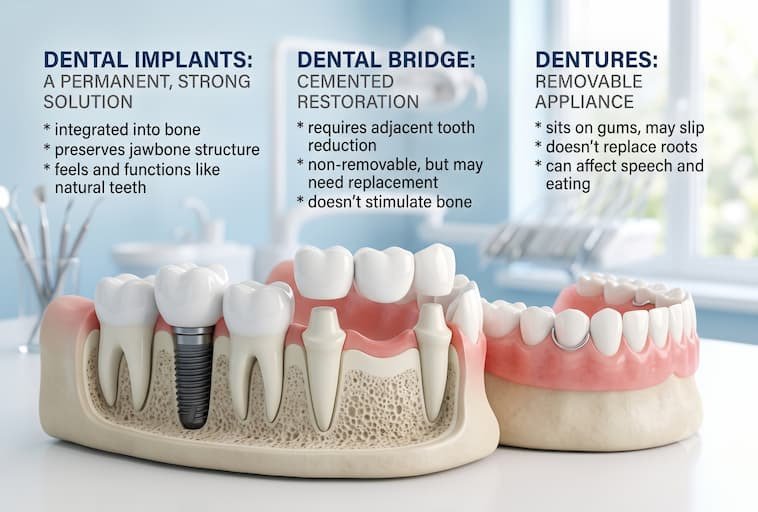
Dental implants are widely considered one of the most durable and functionally reliable options for replacing missing teeth, offering advantages in stability, bone health and longevity that removable dentures and traditional bridges cannot fully match. Understanding these benefits in context helps clarify whether implants are the right fit for an individual situation.
The main benefits of dental implants are that they fuse directly with the jawbone, helping preserve bone density, provide a stable and fixed replacement that functions like a natural tooth, and typically offer greater longevity than dentures or bridges when properly maintained. These benefits come with a longer treatment timeline and higher upfront cost than some alternatives.
What Makes Dental Implants Different From Other Replacement Options?
Dental implants differ from dentures and bridges because they replace the tooth root itself, not just the visible crown, through a titanium or zirconia fixture that fuses with the jawbone in a process called osseointegration. This root-level replacement is the basis for most of their distinct benefits.
- Implants are placed directly into the jawbone, unlike dentures which rest on the gum or bridges which rely on adjacent teeth.
- Osseointegration creates a stable, bone-anchored foundation similar to a natural tooth root.
- Because neighbouring teeth are not used for support, implants don’t require reshaping healthy adjacent teeth as bridges do.
This structural difference explains why implants tend to feel and function more like natural teeth during eating and speaking. A dental clinician will assess jawbone density and general health before confirming suitability, since successful osseointegration depends on adequate bone volume.
Benefits of Dental Implants Over Dentures
The main benefits of dental implants over dentures are stability and bone preservation: implants are fixed in place and help maintain jawbone density, while removable dentures sit on the gum and do not prevent the gradual bone loss that follows tooth loss.
- Implants remain fixed, avoiding the slipping or clicking sometimes associated with removable dentures.
- Implants stimulate the jawbone through chewing pressure, helping preserve bone volume over time.
- Dentures require adhesive and nightly removal for cleaning, while implants are cared for like natural teeth.
Bone loss following tooth loss is a normal physiological process, and dentures do not slow it because they do not transmit chewing forces to the bone in the same way a natural tooth root or implant does. Over years, this can change facial support and denture fit, which is a key reason many patients weigh advantages of dental implants vs dentures carefully before deciding.
Benefits of Dental Implants vs Bridges
Compared with bridges, the benefits of dental implants centre on not requiring alteration of healthy neighbouring teeth: a bridge relies on adjacent teeth being reshaped and crowned for support, while an implant stands independently, preserving those teeth’s natural structure.
- Bridges require reducing the size of healthy adjacent teeth to anchor the crown supporting the bridge.
- Implants do not rely on neighbouring teeth, keeping them untouched and reducing their long-term risk exposure.
- Implants continue to stimulate the jawbone at the site of the missing tooth; bridges do not.
This doesn’t mean bridges are unsuitable — they remain a well-established, faster and often less costly option in the right circumstances. The choice between advantages of dental implants over bridges and a bridge itself depends on the condition of neighbouring teeth, budget, and treatment timeline, which a dental clinician can assess individually. For related restorative context, see dental crowns explained: when you need one, types, benefits and care tips.
Health Benefits of Dental Implants Beyond Aesthetics
Beyond appearance, the health benefits of dental implants include supporting jawbone density, maintaining facial structure, and enabling more normal chewing function, which can support better nutrition compared with an unstable or ill-fitting replacement option.
- Preserving jawbone density helps maintain natural facial contour over time.
- Stable chewing function supports a wider, more balanced diet compared with loose-fitting dentures.
- Reduced pressure on neighbouring teeth, compared with bridges, may support longer-term oral health for those teeth.
These functional health benefits are separate from cosmetic considerations and are often a key factor for patients who have experienced difficulty eating comfortably with previous replacement options. A dental clinician can discuss how these benefits apply based on individual bone health and any existing conditions, such as diabetes, which can affect healing.
Benefits of Teeth Implants for Single-Tooth Replacement
For a single missing tooth, the main benefit of teeth implants is that they replace exactly one tooth without affecting any neighbouring natural teeth, offering a targeted, independent solution rather than requiring wider dental work.
- A single implant addresses one gap without altering the structure of adjacent teeth.
- The surrounding bone at that specific site continues to receive stimulation, reducing localised bone loss.
- Single implants are generally straightforward to match in shade and shape to the surrounding natural teeth.
This makes single-tooth implants a common recommendation where only one tooth is missing and neighbouring teeth are otherwise healthy, avoiding the need to involve them in treatment at all.
Benefits of Full Dental Implants and Full Mouth Dental Implants
For patients missing most or all of their teeth, the benefits of full dental implants (also called full mouth or full arch implants) include fixed, non-removable function and the potential to support an entire arch on a smaller number of implant posts rather than replacing every single tooth individually.
- Full arch approaches, such as implant-supported bridges, can replace a full set of teeth using a limited number of strategically placed implants.
- The fixed nature avoids the day-to-day management associated with a full removable denture.
- Bone stimulation across the arch can help maintain overall jaw structure more evenly than a removable option.
Full mouth implant treatment involves more extensive planning, including detailed imaging and assessment of bone volume across the jaw, and is generally a longer and more involved process than single-tooth replacement. A thorough consultation is essential to determine whether a patient is a suitable candidate for this scale of treatment.
Dental Implants, Dentures and Bridges: A Quick Comparison
| Feature | Dental Implants | Dentures | Bridges |
|---|---|---|---|
| Stability | Fixed, bone-anchored | Removable, can shift | Fixed, but relies on adjacent teeth |
| Bone preservation | Yes, via osseointegration | No | No |
| Impact on neighbouring teeth | None | None | Requires reshaping adjacent teeth |
| Typical treatment time | Longer, includes healing period | Shorter | Moderate |
| Maintenance | Similar to natural teeth | Daily removal and cleaning | Standard oral hygiene, floss threading |
| Suitability | Requires adequate bone density/health | Broadly accessible | Requires healthy adjacent teeth |
UK cost, treatment time and suitability vary by individual assessment and clinic; figures above are general categories rather than fixed guarantees.
FAQ Section
Do the benefits of dental implants apply to everyone missing a tooth?
Not automatically — suitability depends on factors such as jawbone density, gum health and general health conditions that affect healing, which a dental clinician assesses individually. Some patients may need additional treatment, such as bone grafting, before implants are possible.
How long do the health benefits of dental implants typically last?
With good oral hygiene and regular dental check-ups, implants are generally considered a long-term solution, often lasting many years or longer, though the crown attached to the implant may eventually need replacement. Individual results vary based on care and overall oral health.
Are the benefits of dental implants over dentures worth the extra cost for older patients?
This depends on individual health, bone condition and personal priorities rather than age alone, and is best discussed directly with a dental clinician who can assess suitability and realistic expectations. Age by itself is not usually a barrier to treatment.
Can advantages of dental implants vs bridges change if a neighbouring tooth already has a filling? A filled but otherwise healthy adjacent tooth may still be suitable to support a bridge, though an implant avoids involving that tooth at all, which some patients prefer as a more conservative long-term choice. A dental clinician can advise based on the specific tooth’s condition.
Do benefits of full mouth dental implants include faster treatment than replacing each tooth individually?
Full arch approaches can be more time-efficient than placing an individual implant for every missing tooth, though the overall process still involves careful planning and a healing period. Treatment timelines vary based on the specific plan recommended.
Is bone grafting always needed to access the benefits of teeth implants?
Not always — bone grafting is only required when there isn’t sufficient bone volume at the implant site, which is assessed through imaging during the consultation process. Many patients have adequate bone density without needing this additional step.
Do the health benefits of dental implants include preventing further tooth loss?
Implants themselves don’t directly prevent tooth loss elsewhere in the mouth, but maintaining jawbone density at the implant site and avoiding pressure on neighbouring teeth can support better overall oral structure compared with some alternatives. Good oral hygiene remains essential regardless of replacement option chosen.
How soon can I eat normally after implant surgery to experience the benefits of dental implants?
A healing period is required before the implant is fully load-bearing, and dietary recommendations during this time are typically provided by the treating clinician based on the specific procedure performed. Full normal chewing function generally returns once healing and restoration are complete.
Clinical Disclaimer
This article is provided for general educational purposes only and does not constitute personalised dental advice. Individual suitability for dental implants, dentures or bridges should be assessed by a registered dental clinician. If you experience symptoms such as high fever, facial swelling spreading toward the eye or neck, or difficulty swallowing, contact NHS 111 or attend an Accident & Emergency (A&E) department immediately.
