


All-on-4 is an approach to full-arch dental implant treatment in which four strategically positioned implants support a fixed, implant-supported bridge replacing an entire row of upper or lower teeth. It’s designed for people with extensive tooth loss or failing teeth in one jaw, though suitability, planning, and cost vary considerably between individuals. Anyone considering a dentist All-on-4 consultation should go in understanding both the concept and its limitations.
The name causes genuine confusion: four implants doesn’t mean four new teeth — it means four implants supporting a full arch of prosthetic teeth, typically ten to fourteen depending on the design. This guide works through how the concept actually works, who it may suit, what the treatment process and recovery involve, realistic UK costs, and the alternatives worth discussing at a consultation. For a wider look at how implant treatment fits into restorative dentistry generally, understanding the benefits of dental implants is a useful starting point before narrowing down to full-arch options specifically.
What Are All-on-4 Dental Implants?
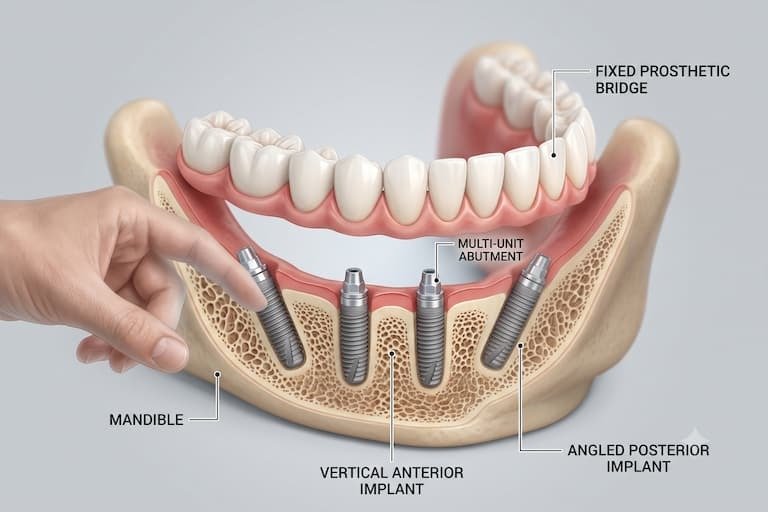
All-on-4 dental implants refer to a full-arch restoration technique in which four implants, positioned at specific angles in the jawbone, support a fixed bridge of prosthetic teeth replacing an entire row of upper or lower teeth, rather than four implants each replacing a single tooth.
The distinction matters because it changes what’s actually being evaluated at a consultation: not “how many teeth am I missing,” but “is this jaw suitable for four implants to bear the load of a full arch.” Upper and lower jaw treatment are planned somewhat differently, since bone density and anatomy differ between the maxilla and mandible, and a patient may need All-on-4 in one jaw while the other jaw has a different treatment plan entirely, including options covered under the wider role of cosmetic dentistry where a full-arch approach isn’t needed.
How Does All-on-4 Work?
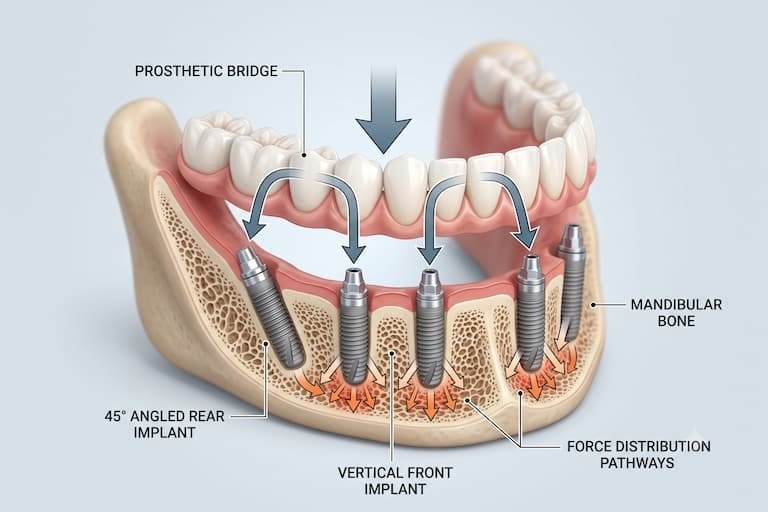
All-on-4 works by placing four implants in the jaw — typically two positioned vertically toward the front and two angled toward the back to make use of available bone — which then support a full-arch prosthetic bridge, distributing biting forces across all four implants rather than relying on individual implants for each tooth.
The angled rear implants are a deliberate design choice, often allowing the technique to work with the bone that’s naturally present in areas where bone loss is common after long-term tooth loss, though this isn’t guaranteed for every jaw. A temporary restoration is often fitted initially, followed by a definitive restoration once healing and integration are confirmed. This sequence, and whether it’s achievable in a specific case, depends entirely on individual anatomy — the technique isn’t automatically suitable for every jaw.
What Does a Full-Arch Dental Implant Treatment Involve?
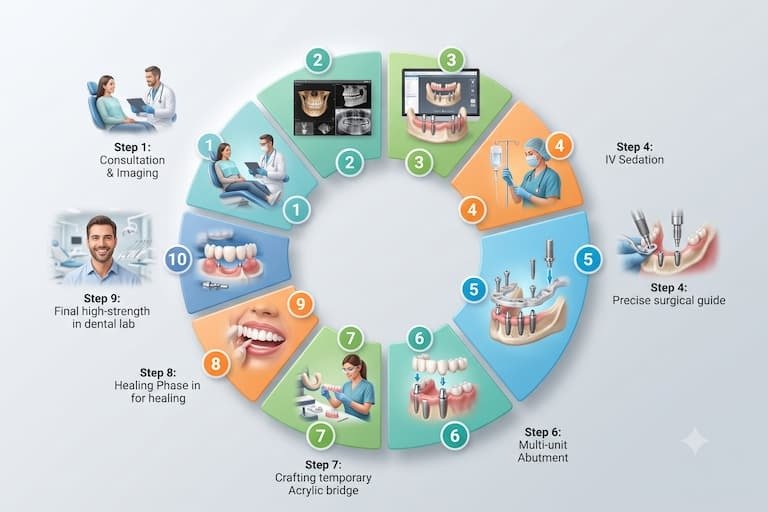
A full-arch dental implant treatment typically involves an initial consultation and imaging, detailed treatment planning, implant placement surgery, a temporary restoration while healing occurs, a healing and integration period, and finally a definitive restoration once the implants are confirmed stable.
Each stage serves a distinct purpose: imaging (often including a CBCT scan) maps the available bone in three dimensions, treatment planning determines exact implant positioning, and the temporary restoration allows the patient to function with fixed teeth while osseointegration — the process by which bone fuses to the implant surface — takes place underneath. Skipping stages, or rushing from temporary to definitive restoration before integration is confirmed, increases the risk of complications later.
What Happens During an All-on-4 Consultation?
An All-on-4 consultation involves a review of medical and dental history, a full oral examination including remaining teeth and gum health, a bite assessment, bone evaluation typically supported by imaging, and a discussion of the patient’s goals, alternatives, risks, and costs before any treatment plan is finalised.
This appointment is where suitability is actually established, rather than assumed from tooth loss alone. A dentist should discuss why All-on-4 specifically is being proposed rather than an alternative, what the imaging shows about bone quality and quantity, and what questions the patient should be asking before committing. A consultation that moves straight to booking treatment without this level of assessment is a reasonable cause for caution.
Who Is Suitable for All-on-4 Dental Implants?
People with multiple missing teeth, extensive tooth loss, or teeth that are failing beyond reasonable restoration may be potential candidates for All-on-4, but suitability depends on bone condition, gum health, general oral health, bite, and the ability to commit to long-term maintenance — not on the amount of tooth loss alone.
Two patients with similar tooth loss can have very different suitability, since one may have sufficient bone volume and healthy gums while the other has significant bone loss or unmanaged gum disease that needs addressing first. Smoking, certain medical conditions, and the patient’s realistic ability to maintain oral hygiene around a fixed prosthesis are also genuine factors a dentist will weigh, not just personal preference for fixed rather than removable teeth.
Is All-on-4 Possible With Limited Bone?
All-on-4 can sometimes work with more limited bone than conventional implant approaches, largely because of how the four implants are positioned and angled to use available bone efficiently, but this doesn’t mean bone grafting is automatically avoided — some patients with more significant bone loss will still need preliminary bone procedures before implants can be placed.
Whether grafting is needed depends entirely on individual imaging and assessment, not on a general rule about the technique. Presenting All-on-4 as a way to sidestep bone grafting for every patient overstates what the approach can do; for some jaws it reduces or removes that need, and for others it doesn’t.
What Is the All-on-4 Treatment Process?
The All-on-4 treatment process generally follows ten stages: consultation, clinical and imaging assessment, treatment planning, any necessary preliminary treatment, implant placement, a temporary restoration, a healing and integration period, definitive restoration, and ongoing follow-up and maintenance.
Preliminary treatment might include extracting failing teeth, treating gum disease, or in some cases bone grafting, depending on what the assessment finds. The definitive restoration is only fitted once osseointegration is confirmed, which is why treatment timelines vary so much between patients — a straightforward case can move through these stages faster than one requiring preliminary treatment and a longer healing period.
How Long Does All-on-4 Treatment Take?
All-on-4 treatment duration varies considerably depending on whether extractions or preliminary treatment are needed, bone and gum condition, healing and integration time, and laboratory stages for the definitive restoration — there’s no single fixed timeline, and claims of guaranteed same-day permanent teeth should be treated with caution.
A temporary restoration is often fitted relatively soon after implant placement in suitable cases, but this is not the same as the definitive, long-term restoration, which typically follows several months later once healing is confirmed. Cases requiring preliminary treatment, such as extractions or bone procedures, will generally take longer overall than those where implants can be placed straightaway.
Is All-on-4 Painful?
All-on-4 implant placement is carried out under local anaesthesia, and while some post-operative discomfort, swelling, and sensitivity are common in the days following surgery, dentists typically aim at minimising discomfort through appropriate pain relief and aftercare guidance — though individual recovery experiences vary.
Most patients report that discomfort is manageable and improves within a week or so, though this depends on the extent of surgery, whether extractions were needed at the same time, and individual healing. It’s reasonable to ask a dentist beforehand what pain relief and aftercare support will be provided, rather than assuming the experience will be entirely pain-free.
What Are the Benefits of All-on-4 Dental Implants?
Potential benefits of All-on-4 include a fixed, implant-supported full arch of teeth rather than a removable option, fewer implants required compared with replacing each missing tooth individually, and a treatment plan that can work with more limited bone in some cases — though outcomes and suitability vary between patients.
These potential benefits need to be weighed against the surgical nature of the treatment, its cost, and the ongoing maintenance a fixed full-arch restoration requires. No dentist can guarantee a specific functional or aesthetic outcome, since so much depends on individual anatomy, healing, and how well the restoration is maintained afterwards.
What Are the Limitations and Risks of All-on-4?
All-on-4 carries risks including implant failure, infection, peri-implant disease, bone loss around the implants, prosthetic chipping or wear, bite-related problems, and the general surgical risks associated with implant placement, alongside the ongoing need for maintenance and the possibility of future repair or replacement.
Peri-implant disease — inflammation and potential bone loss around an implant, broadly similar in principle to gum disease around natural teeth — is one of the more significant long-term risks, and it’s manageable but not eliminated simply because teeth are implant-supported rather than natural. Implant-supported teeth still require the same ongoing dental care and professional monitoring as natural teeth, arguably more given the complexity of a full-arch restoration.
How Long Do All-on-4 Dental Implants Last?
Implant longevity and prosthetic longevity aren’t necessarily the same thing — the implants themselves, once successfully integrated, can potentially last many years or decades, while the prosthetic bridge attached to them may need repair or replacement sooner due to wear, chipping, or changes in fit.
Longevity for both depends heavily on oral hygiene, professional maintenance, gum health, bite forces, whether the patient grinds their teeth, and the material used for the prosthesis. No dentist can guarantee a specific lifespan for either the implants or the restoration, since so many of these factors are within the patient’s ongoing control rather than fixed at the time of treatment.
How Should All-on-4 Teeth Be Maintained?
All-on-4 teeth require daily cleaning both around the prosthesis and underneath it where food and plaque can accumulate, along with regular professional dental reviews and hygiene appointments to monitor gum health and implant stability — maintenance doesn’t stop simply because the teeth are implant-supported and fixed in place.
Specific cleaning tools, such as implant-specific brushes or water flossers, are often recommended to reach areas a standard toothbrush can miss beneath a fixed bridge. Skipping this maintenance is one of the more common contributors to peri-implant disease and can shorten the lifespan of both the implants and the prosthesis, undermining what’s otherwise a long-term treatment investment.
All-on-4 vs Individual Dental Implants
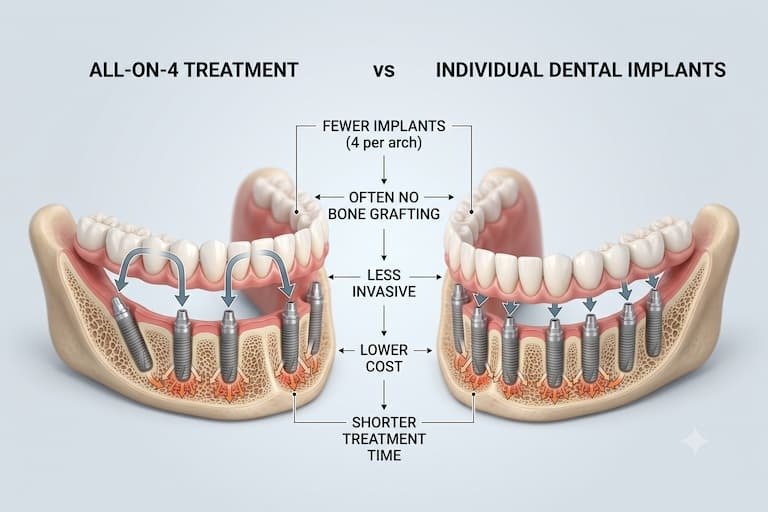
All-on-4 uses four implants to support a full arch of prosthetic teeth, while individual dental implants replace each missing tooth with its own implant and crown — meaning All-on-4 generally involves fewer implants for extensive tooth loss, while individual implants preserve a one-to-one relationship between implants and teeth but require more implants overall for the same scope of tooth loss.
Neither is universally superior. All-on-4 can be more practical and less costly than replacing many individual teeth one by one, particularly with limited bone, but it commits the patient to a single connected restoration rather than independent teeth. Individual implants offer more flexibility if one tooth needs attention later, since neighbouring implants aren’t affected, but this comes at a higher implant count and typically higher overall cost for extensive tooth loss.
All-on-4 vs Dentures
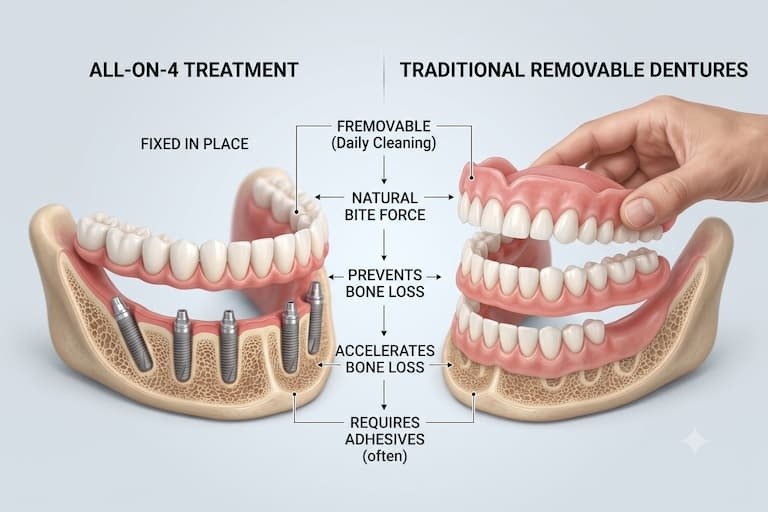
All-on-4 provides a fixed, implant-supported restoration that doesn’t come out, while conventional dentures are removable and rest on the gums rather than being anchored by implants — meaning All-on-4 generally offers greater stability and a more natural biting experience, but requires surgery, higher cost, and a longer treatment timeline than dentures.
Conventional dentures remain an appropriate option for some patients, particularly where surgery isn’t suitable, budget is a significant factor, or bone volume makes implant placement more complex. Implant-supported (rather than implant-fixed) dentures also exist as a middle-ground option, offering more stability than conventional dentures without the full commitment of a fixed All-on-4 restoration.
How Much Do All-on-4 Dental Implants Cost in the UK?
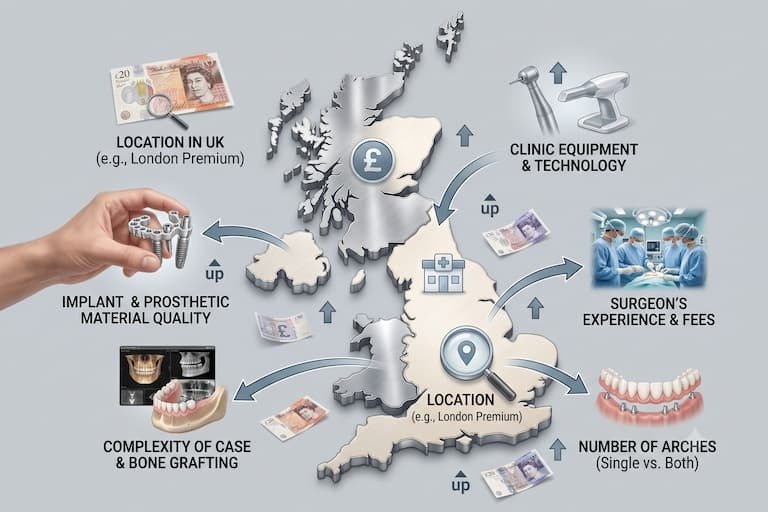
All-on-4 dental implant costs in the UK vary considerably, generally falling somewhere in the region of £10,000 to £25,000 per arch, with the final cost depending on the implant system used, the prosthetic material, whether preliminary treatment such as extractions or bone procedures are needed, imaging, laboratory work, and the treating clinician’s expertise.
Treating both the upper and lower jaw with All-on-4 will cost considerably more than treating a single arch, and this should be clarified early in any quotation rather than assumed. Materials for the prosthesis also affect cost meaningfully — for readers wanting to understand how implant material choice affects pricing more generally, zirconia dental implant cost considerations covers this in more depth, though the figures there relate to implant material costs generally rather than being a direct like-for-like price for All-on-4 treatment specifically.
Is Cheap All-on-4 Dental Implant Treatment Better Value?
Cheap All-on-4 treatment isn’t automatically better value, since a lower headline price can reflect a narrower implant system, lower-cost prosthetic materials, less detailed treatment planning and imaging, or reduced aftercare and complication management rather than genuinely lower-cost equivalent treatment.
Comparing quotations fairly means checking what implant system and prosthetic material are proposed, whether imaging and treatment planning are included, whether both temporary and definitive restorations are covered, and what happens if a complication arises after treatment. A more expensive quote isn’t automatically better either — the same scrutiny should apply in both directions, checking substance rather than price alone.
Is Full-Mouth Dental Implant Finance Available in the UK?
Finance for full-mouth implant treatment, including All-on-4, is available through many UK dental practices, though eligibility, terms, deposit requirements, interest rates, and repayment periods vary between providers and individual circumstances, so no single finance arrangement applies universally.
When comparing finance options, it’s more useful to compare the total amount payable over the full term than the monthly payment alone, since a lower monthly figure can sometimes reflect a longer term with more interest paid overall. This guide doesn’t recommend specific finance providers, since terms change and eligibility is assessed individually.
What Should You Ask an All-on-4 Dentist Before Treatment?
Before proceeding with All-on-4, it’s worth asking why this specific treatment is being recommended over alternatives, what implant system and prosthetic material will be used, what’s included in the quoted price, what happens if an implant fails, what maintenance is required, and what follow-up and repair arrangements are in place.
A dentist who welcomes these questions and answers them clearly is generally a positive sign, while reluctance to discuss alternatives or itemise a quotation is worth treating as a caution. It’s also reasonable to ask how many similar cases the dentist has treated and to request to see examples of previous full-arch cases before committing.
How to Choose an All-on-4 Dental Implant Provider
Choosing a provider is best approached by checking appropriate GDC registration, relevant qualifications and case experience with full-arch implant treatment specifically, clear and evidence-based treatment planning, transparent costs, honest discussion of alternatives and risks, and clear follow-up and maintenance arrangements.
A provider that presents All-on-4 as suitable for every patient without a proper assessment, or that avoids discussing risks and limitations, is a reasonable cause for caution regardless of price. This guide, provided as part of Cosmetic Smile Guide’s medical and editorial guidance, is intended to help readers ask better questions at a consultation rather than to recommend any specific provider.
What Are the Alternatives to All-on-4?
Alternatives to All-on-4 include individual dental implants, implant-supported dentures, conventional removable dentures, and dental bridges where clinically appropriate — with the right alternative depending on the condition of the remaining teeth, gums, and bone, along with the patient’s preferences and treatment goals.
Where tooth loss is more limited, a full-arch approach may not be needed at all, and options such as how dental crowns differ from implant-supported restorations or, for less extensive cosmetic concerns, composite bonding as a different cosmetic option may be more appropriate than any form of full-arch implant treatment. A patient considering a broader smile makeover involving several teeth, rather than a full arch, may also find that guide useful for understanding where a less extensive combination of treatments could achieve their goals.
Before and After All-on-4 Treatment: What Should Patients Understand?
All-on-4 before-and-after photographs can illustrate examples of what’s achievable, but they cannot predict an individual’s own outcome, since facial structure, gum display, tooth proportions, bite, and the specific prosthetic design used all vary between patients and materially affect the final appearance.
A dramatic result shown for one patient reflects that patient’s specific anatomy and treatment plan, not a guaranteed template for anyone else. It’s also worth checking whether a shown “after” photo represents a settled, long-term result or an early temporary restoration, since these can look different once the definitive restoration is fitted and the tissues have fully healed.
Comparison Tables
All-on-4 vs Individual Implants
| Aspect | All-on-4 | Individual Implants |
|---|---|---|
| Treatment concept | Four implants support a full-arch bridge | Each missing tooth gets its own implant |
| Implant numbers | Typically four per arch | One per missing tooth |
| Restoration | Single connected prosthetic bridge | Independent crowns |
| Typical treatment scope | Extensive tooth loss, one full arch | Individual or several missing teeth |
| Suitability | Depends on bone and overall oral health | Depends on bone at each individual site |
| Maintenance | Cleaning around and under a fixed bridge | Cleaning each implant/crown individually |
| Cost factors | Generally lower per-tooth cost for extensive loss | Higher overall cost for many missing teeth |
All-on-4 vs Dentures
| Aspect | All-on-4 | Conventional Dentures |
|---|---|---|
| Fixed/removable | Fixed, implant-supported | Removable |
| Surgical requirement | Yes | No |
| Stability | High | Lower, can shift during eating/speaking |
| Maintenance | Daily cleaning, implant-specific care, reviews | Daily cleaning, periodic relining/replacement |
| Cost | Higher upfront | Generally lower upfront |
| Suitability | Requires adequate bone/oral health for implants | Suitable where surgery isn’t appropriate or preferred |
All-on-4 Treatment Stages
| Stage | What Happens |
|---|---|
| Consultation | Discussion of goals, history, and initial assessment |
| Assessment & imaging | Oral examination, bone evaluation, often CBCT scanning |
| Treatment planning | Implant positioning and restoration design confirmed |
| Preliminary treatment (if needed) | Extractions, gum treatment, or bone grafting |
| Implant placement | Four implants surgically placed |
| Temporary restoration | Fixed temporary teeth fitted, where appropriate |
| Healing & integration | Osseointegration occurs over several months |
| Definitive restoration | Long-term prosthesis fitted once stability confirmed |
| Maintenance | Ongoing hygiene, reviews, and monitoring |
Cost Factors Table
| Cost Factor | Why It Matters |
|---|---|
| Number of arches | Treating both jaws costs considerably more than one |
| Implant system | Different systems carry different costs |
| Prosthetic material | Material choice affects both cost and durability |
| Extractions/bone procedures | Preliminary treatment adds to overall cost |
| Imaging | CBCT and diagnostic imaging are part of proper planning |
| Laboratory work | Definitive restorations require lab fabrication |
| Follow-up and maintenance | Ongoing reviews and potential repairs add long-term cost |
Frequently Asked Questions
Can All-on-4 replace teeth in both jaws?
Yes, All-on-4 can be carried out on both the upper and lower jaw, either at the same time or separately, though treating both arches involves separate assessment, planning, and cost for each.
Can All-on-4 be used after years of wearing dentures?
Often yes, though long-term denture wear can sometimes be associated with bone changes that need assessing first, since available bone affects whether the standard All-on-4 approach or additional preliminary treatment is needed.
Can smokers have All-on-4 implants?
Smoking is a relevant risk factor that can affect healing and long-term implant success, so it should be discussed openly at consultation rather than assumed to rule treatment out entirely.
Can All-on-4 treatment be repaired if the prosthesis breaks?
In many cases, yes — a damaged prosthesis can often be repaired or adjusted, though the specific approach depends on the extent of damage and the design of the restoration.
Are All-on-4 teeth removable by the patient?
No, the definitive All-on-4 restoration is fixed in place and not designed for the patient to remove daily, which distinguishes it from a removable denture, though a dentist can remove it for maintenance if needed.
Can an All-on-4 restoration be changed later?
The prosthesis can potentially be replaced or updated over time, though this typically involves a separate process rather than a simple swap, and should be discussed with the treating dentist.
How should patients clean underneath an All-on-4 bridge?
Specific tools such as implant-specific brushes, water flossers, or superfloss are often recommended to reach beneath the fixed bridge, alongside regular professional hygiene appointments.
What happens if one All-on-4 implant fails?
Implant failure is a recognised risk and management depends on the individual case, potentially involving replacement of the failed implant or adjustment to the restoration; this should be discussed as part of understanding treatment risk beforehand.
Can All-on-4 treatment affect speech?
Some patients notice a temporary adjustment period affecting speech, particularly with a new prosthesis, which often improves as the mouth adapts, though individual experiences vary.
Does All-on-4 require lifelong maintenance?
Yes — ongoing oral hygiene, professional dental reviews, and monitoring of implant and gum health are required for as long as the restoration is in place, similar to caring for natural teeth.
Clinical Disclaimer
This article provides general educational information from Cosmetic Smile Guide and does not replace an individual examination, diagnosis, treatment plan, or advice from a registered dental professional. All-on-4 suitability, treatment design, costs, risks, treatment times, and outcomes vary between individuals and can only be properly assessed following an in-person consultation. For severe symptoms such as spreading facial swelling, swelling affecting the eye or neck, difficulty swallowing, difficulty breathing, or high fever, seek urgent medical help through NHS 111 or an Accident & Emergency (A&E) department.

1 Comment
Pingback: All-on-4 Dental Implants: UK Costs, Risks & Results