


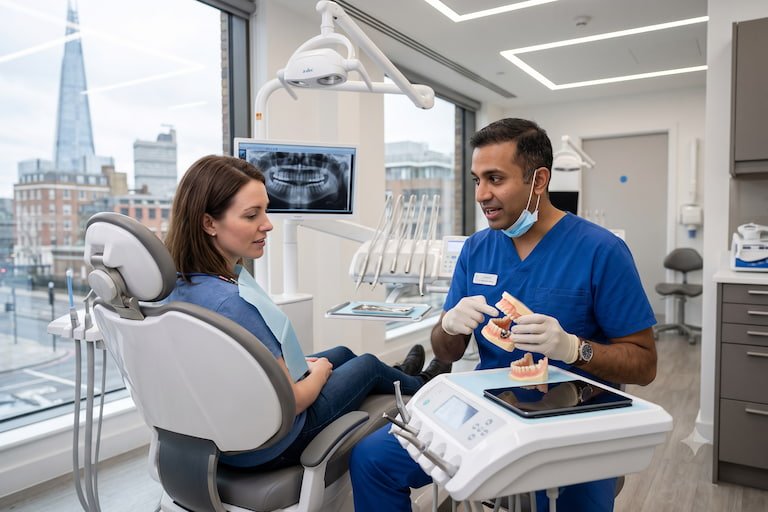
If your tooth has been damaged or weakened, then it could put your smile as well as your oral health at risk. Fortunately, dental crowns provide a long-lasting, durable treatment for restoring strength, function, and the overall look of your tooth. Here is everything that you need to know regarding dental crowns – their different types and benefits, as well as how to care for them.
What is a dental crown?
A dental crown is a cap that looks like a tooth. Crowns are used to restore decayed, broken, weak, or worn down teeth, or to cover up a dental implant or tooth that has undergone root canal therapy.
Crowns cover your whole tooth (like hats cover your head). In order to make sure that the crown fits snugly over your tooth, your dentist must remove a small amount of enamel before cementing the crown in position.
Crowns can be made of a number of materials, such as resin, metal, and porcelain; depending on the material, crowns can last between 5 and 15 years when properly cared for.
When would I need a dental crown?
Crowns can serve different functions. You may need to use a crown for tooth when you:
- want to support a weak tooth
- want to protect or support a cracked tooth
- want to restore a broken down or worn out tooth
- want to maintain a dental bridge
- have a poorly stained or discoloured tooth
- have had root canal treatment
- have had a dental implant
Different Types of Crown for Teeth
A variety of crowns are available for teeth. The type of crown you should have is based on individual choices as well as the unique requirements of your mouth.
Metal Crowns
Many metals can be used to create dental crowns, such as gold, palladium, nickel and chromium. Typically, a crown made of metal won’t chip or break easily, and it has the longest life span with respect to wear and only requires removal of minimal enamel. Moreover, metal crowns can endure the forces you apply to them while chewing and biting. However, some individuals may find the metallic appearance of metal crowns unattractive, so they are especially suitable on molars that are not easily visible.
Porcelain-fused-to-metal (PFM) Crowns
Porcelain-fused-to-metal (PFM) crowns combine an inner metal core with a porcelain outer coating. This allows dentists the ability to match these crowns to the colour of your surrounding teeth.
Although PFM crowns are very strong, there are some disadvantages to them. First, the porcelain coating on these crowns can eventually chip off, exposing the underlying metal. Secondly, PFM crowns can cause gradual wear and tear to the enamel on your opposing teeth – the teeth that touch your PFM crown when you close your mouth.
PFM crowns also have a very long life expectancy, but they may not last quite as long as full metal crowns. PFM crowns are an excellent choice for replacing front and back teeth.
Ceramic Crowns with Pressed Fillers
When an individual has a tooth that requires restoration, two different materials can be used for the restoration – either metal or stripped-down (pressed) inside ceramic filler. The pressed filler is made from a core of pressed, melted ceramic. The process begins by taking the ceramic powder, melting it at a very high temperature and pressing it into the desired shape. Once this core is ready, the lab technician will then proceed to add many layers of porcelain to achieve aesthetics that mimic the light-transmitting properties of natural tooth structure, like many of types of the all porcelain crown.
The drawbacks of using a pressed ceramic teeth cap are the same as a PFM crown as the porcelain layers can fracture over time. A dentist can place a pressed ceramic crown on either a front tooth or back tooth.
All-Ceramic or Porcelain Crowns
Crowns fabricated with all ceramic or porcelain typically may resemble tooth enamel more than any other tooth crown type. If you are someone who does not want to be exposed to metal or you have allergies to metals, you may never want to put a metal restoration in your mouth.
Ceramic crowns can be manufactured using other materials; however, one of the more commonly used materials is zirconium oxide. Zirconium crowns are extremely strong, capable of supporting greater loads than other crown types, and do not contribute to the wear of opposing teeth; they have less abrasion than an unpolished surface.
Same-Day Dental Crowns
Many dentists use CAD/CAM (computer-aided design and manufacturing) technology to make crowns in their offices while you wait. This software enables your dentist to use digital impressions of your teeth to create a custom-designed crown. After your doctor designs your crown, he/she sends the image files to a milling machine that will produce your new ceramic crown from a solid block of material.
The benefit of using CAD/CAM is that you can receive your new crown in only one office visit. However, not everyone is a candidate for same-day crowns so it is best to ask your dentist.
All-Resin Crowns
Crowns made with resins are typically the least expensive option. Therefore, they tend to break easier than PFM or porcelain-fused-to-metal crowns.
Dental resin is typically used by dentists to create temporary crowns that have an expected life span of 3 to 5 years.
What Happens When You Get A Dental Crown?
There are usually two appointments required for getting a crown.
The first appointment is usually for:
- Preparation of the Tooth for a Crown: Your dentist will remove part of your natural enamel from the top surface of your teeth so they can prepare them to fit your new crown properly. This creates enough room between your new crown and the existing tooth so that they will bond adequately together after the crown is placed on the tooth. Your dentist may also use filling material to rebuild or reshape areas of your teeth, if necessary. During this portion of the procedure, the dentist’s goal is to develop a strong foundation for your new crown.
- Creating Impressions: Once your tooth or teeth have been properly prepared and shaped, your dentist will take dental impressions of both the upper and lower arches of your mouth. These impressions can either be taken with physical putty-like material or a digital rubber-like material (with a hand-held scanning device). The impressions will then be sent to a dental laboratory where the technician will create your custom dental crown.
- Placing the Temporary Crown: It usually takes at least two to four weeks (or sometimes longer) from when you are fit with your temporary crown until the crown is fabricated in the dental laboratory and sent back to the dentist’s office. While waiting for the final crown, the dentist will fit a temporary crown, which is generally made out of resin or acrylic.
Your new crown will be sent to your dentist’s office after it has been created by the lab. You will have a second office visit at which your dentist will:
- Remove the temporary crown
- Evaluate the shape, colour and fit of the new crown
- Bond the new crown to your tooth using a high strength dental cement
What are the benefits of dental crowns?
Dental crowns can be very beneficial, especially if you want to keep your natural tooth from wearing out. Some specific examples include:
- Treating broken, worn or decayed teeth
- Preventing your teeth from becoming eroded (due to normal wear and tear)
- Improving the function of your chewing
- Improving the way you look
- Providing at least 5 to 15 years of service when cared for properly
What are the disadvantages of dental crowns?
There are definitely some disadvantages to using crowns, including:
- Taking away some of your natural enamel
- Potentially causing tooth sensitivity for a couple of weeks after placement
- Potentially breaking or cracking over time
- Trapping bacteria between the tooth and the crown, which can lead to decay if the crown does not fit properly
- Causing an allergic reaction (though this is very rare)
- Potentially being expensive
How long until you feel normal after getting dental crowns?
Most people can go back to work or school right away after getting their crowns put in, but there could be some period of time with sensitivity for up to a couple of weeks after the placement procedure and more sensitivity from hot and cold foods and drinks.
You also may experience tenderness or soreness of gums around treated teeth. These are all common occurrences and usually resolve themselves in 48 hours and can be managed with over-the-counter medications for discomfort.
Food to Avoid With Crowns
In general, there are many types of foods to avoid with permanent or temporary crowns. Some examples are:
- Cube ice
- Heavily roasted or very hard nuts (example, chestnuts)
- Un-popped popcorn kernels
- Excessively sticky foods (example, taffy, caramel etc.)
These are not good choices because they can result in damage, removal of crown, or it can lead to your crown falling out or coming off entirely!
Are dental crowns permanent?
Your crown could remain in place for over 30 years with proper regular maintenance. However, if your crowns become cracked or damaged, then that could prevent their continued longevity.
How long do crowns last?
Crowns considered able to be replaced for wear and tear on them have an estimated life span of between 5 and 15 years of age. If you find they seem “worn” or have been damaged at all, then it will soon be time to replace them.
How to Maintain Your Crown
To keep your dental crown in good condition:
- Brush at least twice a day (ideally after every meal) using a fluoride toothpaste and a soft-bristled toothbrush.
- Floss every day between your teeth.
- Rinse with an antibacterial mouthwash daily to help remove bacteria from your mouth.
- Try to avoid hard, crunchy or chewy foods which could dislodge your crowns.
- If you grind or clench your teeth at night (bruxism), talk with your dentist about getting a custom mouth guard.
- Get a professional cleaning and a dental examination every six months.
When Should I Contact My Dentist?
Contact your dentist with any concerns about your crown, including:
- A loose crown
- Persistent bad breath or bad taste
- Cracks or chips in your crown
- Sharp edges irritating your tongue or gum tissue
Will My Crown Hurt?
You should not be in pain from your crown. It is normal to experience some sensitivity to hot or cold after having your crown placed, but you should not be in pain that keeps you from sleeping at night.
If you experience pain during your crown placement, let your dentist know and they will provide additional anaesthetic as needed to ensure your comfort.
Which one should I use: veneers or crowns?
A crown wraps around your whole tooth while a veneer is just a thin layer of porcelain that goes over the front of a tooth. Your teeth will dictate which option you choose based on what you want to accomplish.
- A veneer is used primarily as a cosmetic enhancement to change the look of your tooth by hiding cracks, chips, discoloured teeth, and so forth.
- A crown is used to restore your tooth and improve the health of that tooth with an aesthetic component to it.
What alternatives do I have to a crown?
Depending on your dental goals, there are multiple options you can choose to replace a crown.
- Inlays and Onlays – You will use an inlay or onlay to restore a damaged tooth that has enough remaining tooth structure where the tooth does not require a crown. The inlay or onlay is placed in the defect while retaining most of the tooth structure.
- Veneers – If you have a tooth that is healthy, just has cosmetic issues, you may consider placing veneers over the front teeth. Veneers are custom-made porcelain shells that attach to the front facial surfaces of your teeth. Veneers will also cover cracks, chips, teeth that are not the same colour, etc.
- Extraction of teeth and dental implants – If you have a damaged or badly broken tooth, a crown might not have the required success rate. In these situations, the dentist has the option of extracting your tooth and then replacing it with a dental implant.
Dental cap vs. crown: Does it matter?
There are no differences. Both terms refer to the same restorative item. People tend to refer to crowns as “caps” since they cover your teeth.
Conclusion
Crowns can be used to restore badly worn, badly damaged, or fully decayed teeth. There are numerous types of crowns constructed from a wide range of materials. Which type of crown is best for you depends upon factors such as what you can afford and what you like personally, as well as what you would like to achieve with a given tooth restoration. Generally speaking, crowns are designed to last, but are not indestructible. Eventually, they will have to be replaced. Regularly visiting the dentist as well as maintaining good oral hygiene between dentist visits can prolong the life of your crown substantially.
