


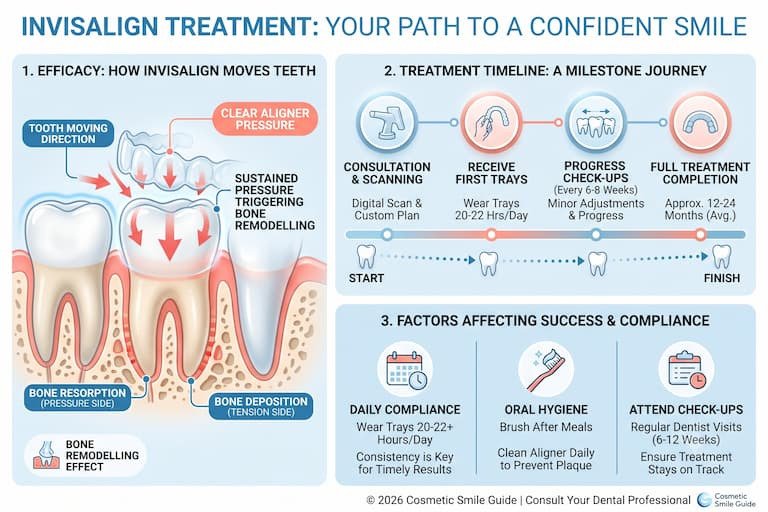
If you’re weighing up Invisalign, the question underneath all the others is a simple one: does it actually work? It’s a fair question — clear aligners look almost too easy compared with the wires and brackets of traditional braces, and it’s reasonable to wonder whether something that removable can really shift teeth the way a fixed brace can. The short answer is yes, for most people, when it’s the right fit for their case and worn as directed. But “does it work” depends a lot on what you’re trying to fix, how complex your case is, and — more than most people expect — how consistently you wear the aligners. This guide walks through the biology behind how Invisalign moves teeth, how quickly results tend to show, and how it holds up against braces for specific problems like overbites, crowding, and missing teeth.
Invisalign sits within a wider field of cosmetic and restorative options, and for readers weighing it against other approaches to improving a smile, our guide to understanding cosmetic dentistry treatments is a useful place to see how it fits into the bigger picture.
Invisalign does work for most patients with mild to moderate orthodontic issues, moving teeth through the same biological process as traditional braces — sustained pressure triggering bone remodelling around the tooth root. Effectiveness depends heavily on case complexity and how consistently the aligners are worn, with results typically becoming noticeable within the first few weeks.
Does Invisalign Really Work?
Yes — for the majority of patients with mild to moderate alignment issues, Invisalign is a genuinely effective way to straighten teeth, and its underlying mechanism is the same biological process used by traditional braces, not a gentler substitute for it.
What sometimes gets lost in marketing is that Invisalign isn’t a shortcut around orthodontic biology — it’s a different delivery method for the same forces. A series of aligners applies calibrated pressure to specific teeth, and the periodontal ligament and surrounding bone respond by remodelling, allowing the tooth to move gradually into its new position. Clinical research and orthodontic consensus support Invisalign as effective for a defined range of cases; the more relevant question for most people isn’t “does it work at all” but “does it work for my case,” which is what the sections below get into.
How Does Invisalign Work to Move Teeth?
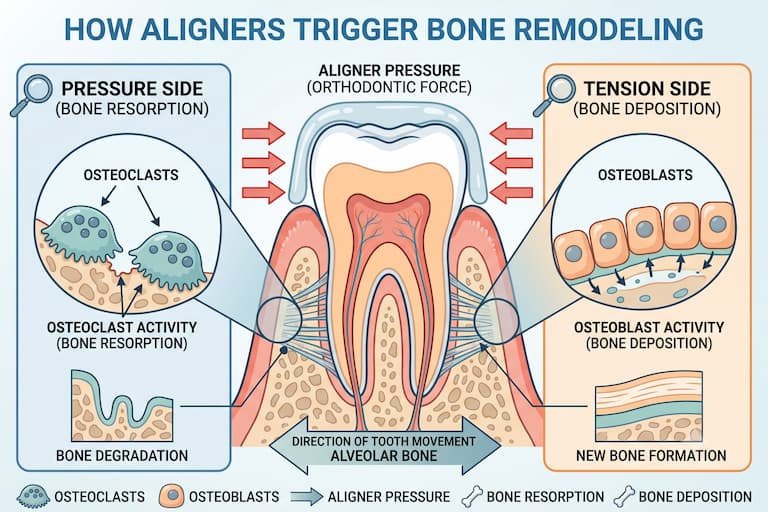
Invisalign moves teeth by applying continuous, controlled pressure through a series of custom aligners, each one slightly different from the last, which encourages a natural process called bone remodelling — the same biological mechanism that allows any orthodontic appliance to shift teeth over time.
When sustained pressure is applied to a tooth, bone on the pressure side is gradually broken down while new bone forms on the opposite side, letting the tooth migrate into a new position without damaging the tooth itself. SmartTrack aligner material is designed to apply this pressure more gently and consistently than earlier aligner materials, which is part of why modern Invisalign tends to be more comfortable than older clear aligner systems. Before any aligners are made, a digital scan is used to build a ClinCheck treatment plan, mapping out each incremental movement in sequence — so, in a real sense, the “work” is planned out biomechanically before treatment even begins.
How Fast Does Invisalign Work?
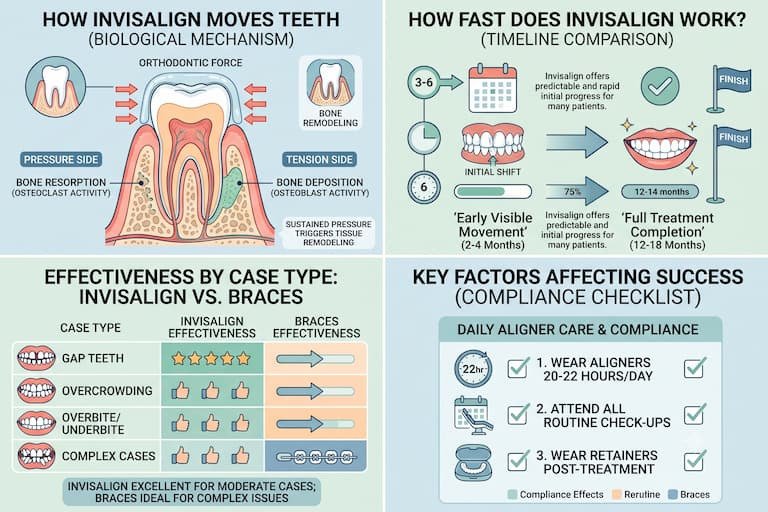
Most patients notice some visible movement within the first few weeks of starting treatment, though “how fast Invisalign works” really refers to two different things — how quickly individual teeth respond to each aligner, and how long the overall course of treatment takes to reach the final result.
Each aligner is typically worn for one to two weeks before moving to the next in the series, and within that window it’s common to feel pressure and see small shifts. But early movement isn’t the same as being finished — full treatment for even straightforward cases usually runs several months, and more complex bite corrections take longer. A common misconception worth clearing up here: Invisalign is not inherently faster than braces overall. In some mild cases it can achieve similar results in a similar or slightly shorter timeframe, but in more complex cases braces may actually progress faster, because they don’t rely on the patient removing and replacing anything.
How Long Does Invisalign Work Before Results Are Visible?
Visible changes are often noticeable within the first month for cosmetic-focused cases like mild crowding or spacing, while more structural changes — such as bite correction — tend to take several months of consistent wear before the difference becomes obvious.
It helps to think of “visible results” and “finished treatment” as two separate milestones. A patient with minor spacing might see a meaningful visual difference after a handful of aligner changes. Someone correcting an overbite is working toward a change in how the upper and lower jaw relate to each other, which is a slower, more gradual process — early aligners may not look dramatically different from the last, even though the underlying bite relationship is shifting.
Does Invisalign Work as Well as Braces?
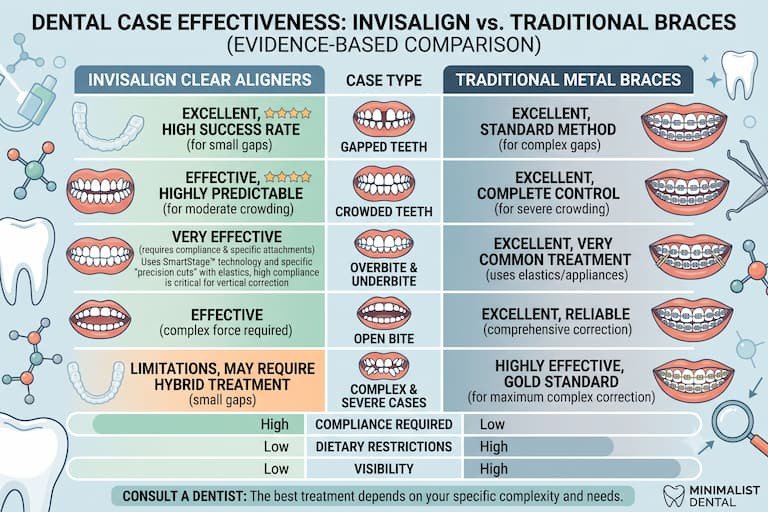
For mild to moderate cases, Invisalign is generally considered comparably effective to traditional braces, though for more complex bite discrepancies, braces are often still regarded as the more predictable option, since they don’t depend on the patient consistently wearing and swapping aligners.
| Comparison Point | Invisalign | Traditional Braces |
| Effectiveness for mild–moderate cases | Comparable | Comparable |
| Effectiveness for complex cases | More variable | Generally more predictable |
| Dependence on patient compliance | High | Low (fixed to the teeth) |
| Precision for certain rotations/vertical movements | Can be more limited | Often more precise |
The honest way to frame this: Invisalign “works as well as braces” for a defined range of problems, not universally. A dental clinician assessing your bite is really assessing which category your case falls into.
Does Invisalign Work the Same as Traditional Braces?
Not exactly — while both systems rely on the same biological principle of sustained pressure moving teeth, they apply that pressure differently, which affects which types of movement each is best suited to.
Braces use brackets and wires to apply near-constant force across the whole arch, which can make them more effective for movements like tooth rotation or vertical repositioning. Invisalign applies pressure through the shape of the aligner itself, sometimes assisted by small attachments bonded to specific teeth to give the aligner extra grip for more difficult movements. For many common issues — crowding, spacing, mild-to-moderate bite problems — this difference doesn’t meaningfully change the outcome. For more complex mechanical movements, it can.
Does Invisalign Work Better Than Braces?
Not universally — “better” depends entirely on the case. Invisalign tends to offer advantages in appearance, removability and comfort, while braces often have an edge for complex movements and don’t rely on the patient’s day-to-day compliance to stay on track.
If your priority is discretion, or you want to remove your aligners to eat and clean your teeth normally, Invisalign has a clear practical advantage. If your case involves significant rotation, vertical bite issues, or you have a history of not following through with removable devices, braces may actually be the more reliable route to a good result. Neither is objectively “better” — they’re suited to different situations and different patients.
Does Invisalign Work for Overbite?
Invisalign can effectively treat many mild to moderate overbites, often using specific attachments or elastics to help correct the bite relationship between the upper and lower teeth, though more severe overbites may need a combined or alternative approach.
Overbite correction is one of the areas where treatment planning matters a lot. A dental clinician will typically use a digital scan to assess how much the bite needs to shift and whether Invisalign alone can achieve that safely, or whether elements like precision attachments, elastics, or even a referral for a more involved orthodontic approach would serve the case better.
Does Invisalign Work on Crooked Teeth?
Yes, in many cases — Invisalign is commonly used to treat mild to moderate crowding and misalignment, which is one of the most frequent reasons adults seek treatment in the first place, though very severe crowding may need additional planning, such as interproximal reduction.
Interproximal reduction (IPR) — carefully removing a small amount of enamel between certain teeth — is sometimes used to create space where crowding is too tight for teeth to shift into place without it. This is a normal, planned part of many Invisalign cases rather than a sign that something has gone wrong with the treatment.
Does Invisalign Work for Complex Cases?
Invisalign can work for some complex cases, particularly with newer aligner systems and features designed for more difficult movements, but very severe malocclusion, significant vertical discrepancies, or cases needing surgical input are often still better managed with traditional braces or a combined orthodontic-surgical approach.
This is one of the more nuanced points that general marketing tends to smooth over. “Complex” isn’t one category — a case can be complex because of crowding severity, because of how the jaws relate vertically, or because of tooth rotation, and each of those responds differently to aligner-based treatment. This is exactly why an individual assessment, rather than a general rule, determines suitability.
Does Invisalign Work If You Have Missing Teeth?
Invisalign can often still be used with missing teeth, but the treatment plan needs to account for the gap directly — sometimes closing it through tooth movement, sometimes maintaining space for a future restoration like an implant or bridge — which makes case planning more involved than a standard case.
This is a scenario that’s frequently under-explained. Missing teeth change how forces distribute across the arch, and a clinician needs to decide, before treatment starts, whether the plan will close the space, redistribute it, or preserve it for restorative work later. Getting this sequencing right is part of why missing-tooth cases usually need more detailed treatment planning up front.
What Factors Affect Invisalign Success?
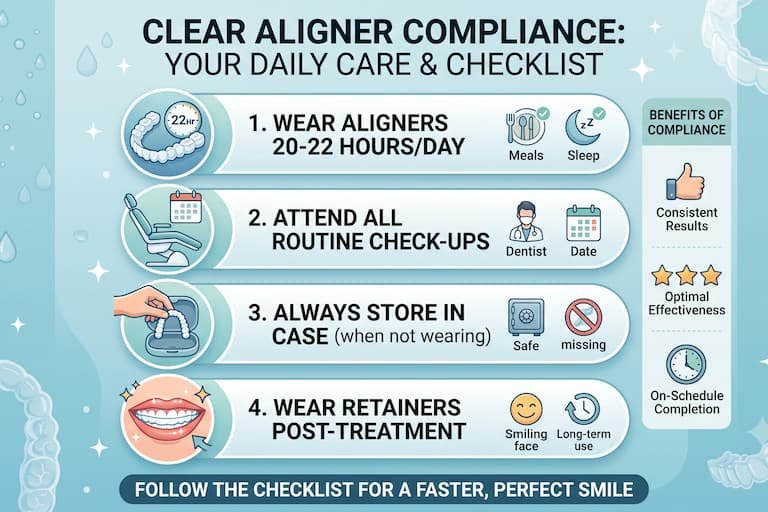
Several factors influence whether Invisalign achieves the planned result: case complexity, how consistently the aligners are worn, whether attachments or refinements are used correctly, and how the individual’s biology responds to the applied pressure.
Compliance is worth calling out specifically, because it’s arguably the single biggest controllable factor in whether treatment succeeds on schedule. Aligners are generally intended to be worn around 20–22 hours a day; falling meaningfully short of that doesn’t just slow things down; it can cause aligners to stop tracking properly, meaning they no longer fit the current tooth position as intended, which often means extra refinement aligners and a longer overall timeline. Missed check-ups can also let small tracking issues go unnoticed for longer than they should.
Situations Where Invisalign May Not Be the Best Option
Invisalign may not be the ideal choice for patients with severe malocclusion, significant vertical bite discrepancies, certain complex rotations, or a history of inconsistent compliance with removable devices — in these situations, traditional braces or a combined approach are often more predictable.
- Severe crowding or spacing beyond what aligners can reliably manage
- Significant open bite or other vertical bite discrepancies
- Complex tooth rotations that need more mechanical precision than aligners typically provide
- Patients who are unlikely to wear aligners consistently for the recommended hours
None of this means Invisalign “doesn’t work” in these cases — it means the odds of a predictable, on-schedule result are lower, which is exactly the kind of thing worth discussing openly with a dental clinician before starting.
Maintaining Results After Invisalign
Long-term results after Invisalign depend on consistent retainer wear, since teeth have a natural tendency to drift back toward their original position once active treatment ends — retainers are what hold the corrected position in place over time.
Most clinicians recommend wearing a retainer indefinitely, at least part-time, well after the active aligner phase is complete. Skipping this step is one of the more common reasons people see their teeth gradually shift back over months or years, undoing progress that took months of consistent aligner wear to achieve. If you’re also considering how a straighter smile fits alongside other cosmetic goals, our overview of other smile enhancement options covers what tends to come after orthodontic work for people planning a fuller smile makeover.
For patients thinking about refining tooth shape or covering minor imperfections once alignment is complete, our guide to cosmetic bonding treatment explains a commonly used next step, and our comparison of comparing cosmetic treatment choices can help with weighing bonding against veneers for that stage.
Conclusion
Invisalign works — genuinely and predictably — for the majority of people with mild to moderate orthodontic issues, using the same underlying biology as traditional braces. Where it gets more nuanced is in complex cases, missing-tooth situations, and anything that depends heavily on consistent day-to-day compliance, where braces sometimes have the edge. The most reliable way to know whether it will work for your case specifically is a proper assessment from a GDC-registered dental clinician, who can map your case against what aligners can realistically achieve. For those exploring the fuller picture of what’s possible for a smile beyond alignment, our guide to understanding veneer treatment options and our piece on planning a complete smile makeover are worth a read once you’ve got orthodontic treatment sorted.
5. Comparison & Data Tables
Mild, Moderate and Complex Cases
| Case Type | Examples | Invisalign Suitability |
| Mild | Slight spacing, minor crowding | Generally well suited |
| Moderate | Moderate crowding, mild-to-moderate overbite | Often suitable, may need attachments |
| Complex | Severe crowding, vertical bite discrepancies, significant rotation | Variable — often better suited to braces or combined approach |
Expected Treatment Times
| Case Complexity | Typical Duration |
| Mild, cosmetic-focused | A few months |
| Moderate | Around 6–12 months |
| Complex | 12 months or longer, where suitable at all |
Factors Affecting Success
| Factor | Effect on Outcome |
| Compliance (wear time) | Directly affects whether treatment stays on schedule |
| Case complexity | More complex cases carry more variability in outcome |
| Attachments/elastics use | Support more difficult movements when correctly used |
| Missing teeth | Requires more detailed upfront planning |
| Attendance at check-ups | Allows early correction of tracking issues |
Suitable vs Unsuitable Candidates
| Generally Suitable | May Need Further Assessment or Alternative Treatment |
| Mild-to-moderate crowding or spacing | Severe crowding beyond aligner capacity |
| Mild-to-moderate overbite | Significant open bite or vertical discrepancies |
| Patients able to commit to consistent wear | Patients unlikely to maintain compliance |
| Straightforward missing-tooth cases with planning | Complex multi-tooth restorative needs |
FAQ Section
1. Can Invisalign fail even if I wear it as instructed?
It’s uncommon but possible — some cases don’t respond exactly as planned due to individual biological variation, and refinement aligners are sometimes needed partway through to adjust the plan and keep treatment on track.
2. Is Invisalign slower than braces for correcting an overbite?
Not necessarily, though it can be, depending on how significant the overbite is. Mild-to-moderate overbites are often treated in a comparable timeframe, while more complex bite corrections may progress faster with fixed braces.
3. Why do some Invisalign cases need refinement aligners?
Refinements are additional aligners made partway through treatment to fine-tune movements that didn’t track exactly as planned. This is a normal part of many treatment courses rather than a sign that something has gone wrong.
4. Does Invisalign work for teenagers as well as adults?
Certain Invisalign systems are specifically designed for teenagers, accounting for growing teeth and including compliance-tracking features, though suitability should still be confirmed by a clinician on a case-by-case basis.
5. Can Invisalign correct a crossbite?
In many mild-to-moderate cases, yes, often using attachments to help apply the specific type of pressure a crossbite correction requires. More complex crossbite cases may need additional orthodontic input.
6. Will my teeth move back after Invisalign if I stop wearing my retainer?
Yes, this is common. Teeth have a natural tendency to shift back toward their original position without ongoing retainer wear, which is why most clinicians recommend indefinite, at least part-time, retainer use after active treatment ends.
7. How do I know if Invisalign will work for my specific case?
The only reliable way is a full assessment, including a digital scan, by a GDC-registered dental clinician, who can map your bite against what aligner treatment can realistically achieve for your situation.
8. Does Invisalign work as well for adults as it does for teenagers?
Yes, in general — tooth movement biology doesn’t fundamentally differ by age, though adults may have additional factors, such as previous dental work or gum health, that a clinician will take into account during planning.
9. Can Invisalign work if I’ve already had braces before?
Often, yes — Invisalign is commonly used to correct relapse after previous orthodontic treatment, though the case will still need an individual assessment to confirm suitability.
10. Does Invisalign work the same way for upper and lower teeth?
The underlying biological process is the same, but treatment plans often move the upper and lower arches at different paces depending on the specific correction needed, which is mapped out in the digital treatment plan before aligners are made.
Clinical Disclaimer
This article is intended for general educational purposes and does not constitute personal dental or orthodontic advice. Whether Invisalign will work for a specific case can only be determined through an in-person assessment by a GDC-registered dental clinician. Treatment outcomes, timelines, and long-term stability vary between individuals and are not guaranteed. If you experience severe pain, facial swelling, or difficulty eating or speaking that does not improve, contact your dental clinician, or NHS 111/A&E if symptoms are severe. Content has been prepared with reference to current UK dental guidance and evidence hierarchy (NHS, NICE, GDC, and peer-reviewed literature) and is clinically reviewed against current UK dental guidance.
