

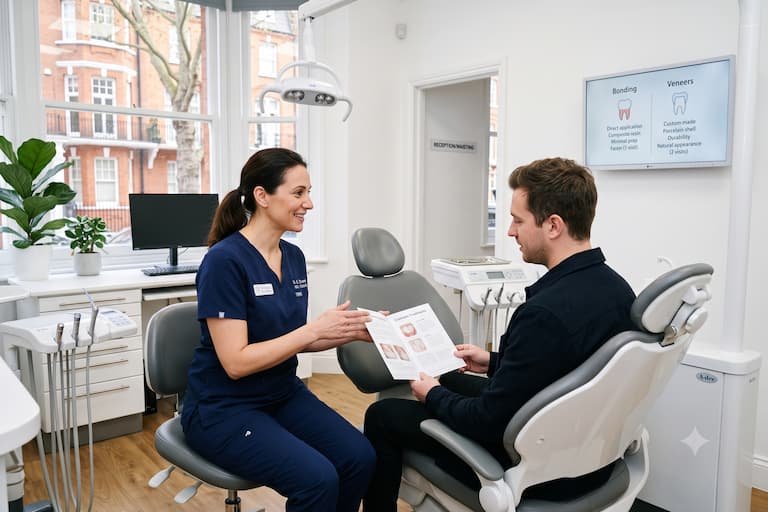
Who does not want a beautiful smile? People, who have naturally beautiful white teeth but want whiter teeth and cannot find a way to achieve that, normally opt for either composite bonding or composite veneers instead. The names may sound similar, but there are distinct differences between bonding and veneers. If you wish to be proud of your smile, it would be advisable to look into cosmetic dental options like bonding and veneers.
You may be wondering what the difference between composite bonding and veneers are? And how do you determine which one would be best for your teeth? Let us take a closer look at each of them.
What is Cosmetic Dentistry?
First, you need to know what cosmetic dentistry is.
Cosmetic dentistry is not the same as regular dentistry. Regular dentistry repairs your teeth and keeps your mouth comfortable through procedures like fillings and root canals, and allows your teeth to last as long as possible. Cosmetic dentistry is simply enhancing the appearance of your teeth through a variety of procedures, including reshaping your gumline, closing any gaps between your teeth and whitening your teeth.
You can achieve the visual outcome you desire from your teeth through multiple means to whiten them, whether you utilise professional whitening systems, at-home whitening strips, toothpaste or a combination of whitening products. But they do not reach the same cosmetic level as using composite veneers or composite bonding technologies. Both of these procedures will enhance both the aesthetic appearance of your teeth by providing you with a bright white colour, as well as improve the overall look of your teeth in many other ways as well.
Composite Bonding
Composite bonding has evolved over time from its initial use on the backside of your back molars only, to now being applied to the front side of your teeth using composite materials that are just as durable and opaque for cosmetic purposes. Composite bonding can repair minor chips in the edges of your front teeth or fill in small gaps between your front and back teeth.
With composite bonding, your dentist will shape up the edges of your teeth by adding some length if necessary, which allows for a nicer smile that matches your gum line. It also fixes any of the small issues on the edges of your teeth, as we have described earlier, such as cracks and gaps. Once your tooth has been shaped, it will be whitened so that the dental bonding material will match the rest of your teeth colour and won’t stand out. To accomplish this, your dentist needs to match your original tooth colour with the bonding material used to restore your original tooth.
Composite bonding requires some drilling of your tooth surface to allow for a proper bond between your original tooth and the bonding material. How much of the original surface is removed is determined by the condition of the underlying tooth and the desired outcome of the patient.
Since the use of composite edge bonding is limited to the edges of the teeth and filling small areas of defect, it is not suitable for extensive tooth repairs. For more significant tooth repairs, the use of composite veneers is necessary.
Composite Veneers
The purpose of veneers is to ultimately cover the front of your tooth. You may be familiar with porcelain veneers; they are one of the most common ways to enhance the look of your smile while still being somewhat invasive to the patient. Porcelain veneers will require you to shave down (removing enamel) the existing tooth before placing the porcelain veneer on top, in essence bonding the two together creating an instant fixed improvement of the original. This is considered a permanent procedure but will require upkeep and many times the new veneers are going to be needed over time.
Composite veneers, although performed similar to porcelain, are made from a composite resin which is the same type of material that was used in composite bonding. However, the composite veneer is not designed to cover just a portion of the tooth, it covers the entire tooth.
So why would you want a composite veneer instead of a porcelain veneer? The cost of a composite veneer is less than that of a porcelain veneer; however they perform the same function. The time involved in the application of a composite veneer may take less time to complete due to the requirement of only general anaesthesia versus topical anaesthesia, and a composite veneer will take only a couple of hours compared to the six or more hours for a porcelain veneer.
Composite veneers are an excellent choice if you want to rectify slightly irregularly shaped teeth – one tooth that is noticeably pointier than another or small gaps between teeth that are bothering you. The end result will be a much better-looking smile!
Although composite veneers could be considered “permanent” because they require you to shave down much of the tooth structure underneath, it does not mean you do not need to take care of your new teeth. They are still very fragile and require proper maintenance. If you take care of your composite veneers, they should last about 10 years on average, so long as they are maintained as recommended.
Spotting the Differences
Composite bonding and veneers are two types of treatments offered to enhance the appearance of your smile. Both treatments have their similarities, but each has its own material types, purpose, duration of preparation, and cost.
Purpose
- The purpose of composite bonding is to correct or repair imperfections in the structure or shape of your teeth such as chipped, cracked, broken, or worn down, to fill the gap between teeth, the treatment of tooth discolouration or to improve how your teeth appear.
- The purpose of composite veneers is to change the shape, size or colour of any tooth that may appear to be too light, too distorted or defective. Composite veneers will make significant changes to the appearance of your smile.
Durability
- While composite bonding is durable, it does not typically hold up well against staining and does not typically last as long as composite veneers. The colour of composite bonding will be at risk for fading from the ingredients used in foods and beverages such as coffee, tea, soda, alcohol and tobacco use.
- Composite veneers have an extremely high level of stain resistance and are generally much more durable than composite bonding. If maintained properly with good oral hygiene, composite veneers will last for a long time.
Preparation
- To bond a tooth, minimal preparation is required. The dentist roughens the surface of the tooth and applies the bonding material directly on top of the tooth.
- To prepare a tooth for a veneer, the dentist generally removes approximately 0.5 mm of enamel from the tooth to make room for the veneer. This alteration to the tooth is permanent.
Cost
- Bonding is generally less expensive than veneers because bonding is typically faster, requires less removal of tooth structure and does not require custom fabrication for minor cosmetic corrections.
- Veneers are custom-made and are more costly than bonding. Because enamel has to be removed from the tooth before placing the veneer, veneers are intended to be placed only in cases where it is appropriate, not routinely.
Your dentist will evaluate your particular dental needs and recommend the best option between bonding and veneers based on the degree of the cosmetic problem and your payment ability.
Composite Bonding vs. Composite Veneers: Making the Right Choice
When considering whether to implement composite bonding or composite veneers, consider several factors, including the difference in procedure and how each utilises the same material.
Composite bonding is typically done by bonding to the edges of teeth, where small chips or spaces are filled in with an adhesive material that matches the colour of the cleaned natural tooth. Before composite bonding can be performed, the teeth need to be whitened to ensure that the resin matches well.
Composite veneers cover the entire surface of the tooth rather than just the edges as with composite bonding. Therefore, you do not have to worry about lightening or whitening your teeth before the veneers are placed. Instead, the teeth are shaved down to allow for the thickness of the composite material, which prevents the appearance of thickness at the bottom of the tooth. Composite veneers also provide an excellent means of correcting all dental problems virtually and provide a beautiful result when done correctly. If you are considering composite bonding vs. composite veneers, please contact our cosmetic dental clinic for help with your decision-making process and to receive the beautiful white smile you have always wanted!
