

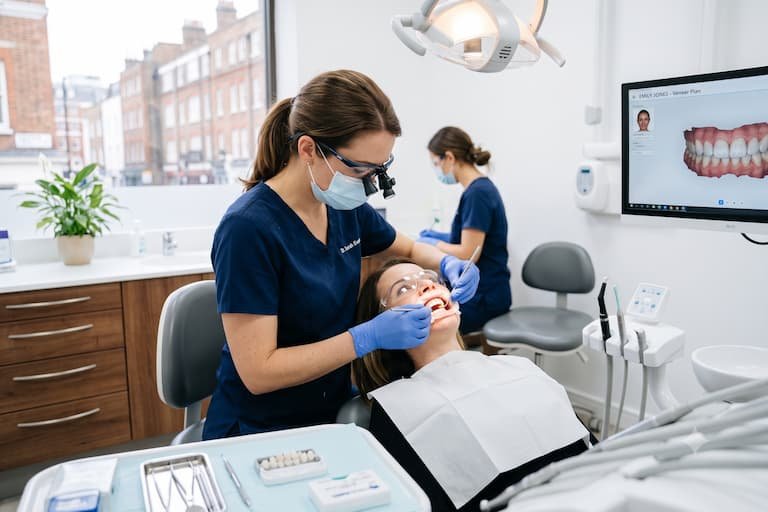
If you hide your smile because of stains, chipped teeth or gaps, dental veneers could be the solution for you. Veneers are thin, natural-looking coverings that go on the front of your teeth to give you a boost of confidence in your smile.
What are veneers?
Dental veneers are custom-made shells that are created by technicians from premium dental materials to fit over the front surface of your teeth. They come in two materials – composite and porcelain – both of which match the colour of your existing teeth.
Dental veneers are cosmetic restoration appliances, designed to hide several aesthetic defects, including chips, cracks, gaps, discoloured teeth and any other cosmetic issues you wish to correct.
How do veneers work?
Dental veneers cover the front of your teeth to make your smile look more attractive by hiding cosmetic flaws.
Who is a candidate for dental veneer restoration?
Anyone who wants a more attractive smile can benefit from the use of dental veneers. Dental veneers can eliminate:
- Chipped or broken teeth
- Diastema – gaps or spaces in your smile
- Stains that do not come out with teeth whitening
- Excessively small teeth
- Teeth that are misshapen
You should know that you can have dental veneers only if you do not have multiple cavities or gum disease. If you have serious oral health problems, they should be taken care of prior to beginning any cosmetic work.
What are the different types of veneers?
1. Porcelain Veneers
Porcelain veneers are known as traditional veneers. They were originally intended as a short-term fix to help enhance actors’ smiles back in the 1930s. These are thin ceramic shells that will be attached to the front side (or facial surface) of your teeth. They are very popular for people who want a permanent, beautiful smile, and with adequate dental maintenance, they can last 10 to 20 years.
2. Dental Lumineers
Lumineers are a specific brand of veneers known for being both the slimmest and strongest type of dental veneer. Lumineers are approximately as thin as contact lenses. The application process for lumineers requires two trips to the dentist, is totally painless, and you do not need to grind down any of your existing tooth structure. They will last over 20 years and may be removed easily if so desired.
3. Composite Veneers
Composite veneers or bonded veneers are an inexpensive and less damaging method of obtaining a better smile. Composite veneers use composite materials applied directly to the facial surface of your front teeth that are polished and smoothed to create a natural appearance. While composite veneers may give you the smile of your dreams, they are less durable than porcelain, and thus more susceptible to chipping and staining. Moreover, composite veneers can easily be repaired, but they usually only last five to ten years on average.
4. Palatal Veneers
Veneers for the palatal aspect of teeth are typically made of gold; additional options include porcelain or composites. They are used specifically to treat and manage wear of the upper teeth.
5. Non-Permanent or Removable Veneers
Non-permanent or temporary veneers are used prior to placement of porcelain veneers and for the purpose of achieving temporary, easily removable veneers. These types of veneers are made of a flexible type of resin or plastic material. Temporary veneers can be a temporary solution until the permanent veneers are complete.
What happens before dental veneer placement?
At your first visit, your dentist will evaluate your teeth and gums to see if you are eligible for veneers. If you qualify, your dentist will prepare your teeth by removing some of the outer enamel from your teeth. The dentist will then take impressions of your teeth. A dental laboratory will use these impressions to create your custom veneers. Dental impressions are not needed if you choose to use composite veneers.
Your dental laboratory typically takes two to three weeks to finish your veneers. If necessary, your dentist can place temporary veneers during this time to protect your teeth until the technician completes your veneers, at which point they will send them to your dentist.
What happens during veneer placement?
At the time of your second visit, your dentist will examine your veneers’ size, colour and fit. Your dentist will then permanently bond the veneers to your teeth with dental cement. Finally, they will check your bite alignment and make any adjustments necessary for optimal fit.
If you have any additional requests regarding your veneers, i.e., shape or colour, please speak with your dentist about your options. Your dentist can work closely with the dental lab to ensure that you receive the desired results.
After receiving your veneers, you can resume your daily routine immediately. You can also eat or drink right after your appointment, provided the anaesthesia has worn off.
Do dental veneers need special care?
To maintain your veneers, you only need to brush and floss and see your dentist regularly. It is important to use a soft-bristled toothbrush and non-abrasive fluoride toothpaste to care for your veneers. You should not use whitening products as these may scratch your veneer surface.
In addition, to prolong the life of your veneers, do not bite directly into hard or crunchy food items, such as apples, carrots, or tough meats. Instead, cut up such food items and chew them with your back teeth.
Even though porcelain veneers can resist stain, it is advisable to limit certain dark coloured foods and drinks such as berries, red wine, coffee and tea. With time, these things will eventually cause staining on your veneers.
What are some advantages of dental veneers?
There are multiple reasons to use dental veneers, including:
- Veneers enhance the look of your smile dramatically.
- They will have the same life-like results as your natural tooth.
- They resist staining and discolouration more than your natural tooth enamel.
- Dental veneers do not require any additional care.
- They can last from 10 to 15 years with proper care.
What are some disadvantages of veneers?
Dental veneers have some disadvantages that should be considered, including:
- You will lose some of your natural enamel.
- Most types of veneers are not reversible.
- You may experience increased sensitivity to hot and cold temperatures.
- It is possible for a veneer to become dislodged or fall off.
- Dental veneers are considered cosmetic and are generally not covered by dental insurance.
How do I keep my veneers in great condition?
To help keep your dental veneers appearing and feeling great, follow these tips:
- You need to brush your teeth twice each day with a soft-bristle toothbrush and effective fluoride toothpaste that does not scratch or abrade your teeth.
- Floss your teeth every day.
- Use anti-bacterial mouthwash every day at least twice a day.
- Do not use your teeth for anything other than chewing food and drinking water. For example, do not use them to open boxes or remove clothing tags.
- See your dentist regularly for check-ups and cleaning.
Alternative Treatments to Veneers
The alternatives to veneers include crowns, bonding, or creating dental implants. Veneers are an ideal choice for someone who would like to cover more of the tooth’s surface area than bonded teeth but does not want to cover the entire tooth surface like a crown.
Veneers vs. crowns
The easiest way to remember this is that veneers are like facelifts for teeth, whereas crowns are mainly used to restore the structural integrity and strength of damaged or decayed teeth. Veneers will cover the front surface of your tooth only to improve its appearance. They are purely cosmetic procedures whereas; crowns will provide both looks and functioning improvement.
Veneers vs. implants
If you have healthy teeth, then your best option would be to look at getting some veneers for your teeth. Veneers enhance the colour of your teeth, as well as hide unsightly gaps, etc. Implants are recommended if you have unhealthy teeth or those that are missing due to disease or trauma. The cost of veneers is about one-third of that of implants.
Veneers vs. teeth bonding
Tooth bonding is a procedure for cosmetic improvement to discoloured, crooked or chipped teeth. A tooth-coloured composite resin is glued on the tooth by a dentist. In contrast to the veneers, the dentist will not have removed a lot of enamel from your teeth for the purpose of performing the dental bonding. Bonding needs to be touched up about every 3 to 10 years and is a reversible process. Most of the time, veneers cannot be reversed.
Veneers vs. dentures
Veneers provide an excellent cosmetic way to transform the aesthetics of your smile. On the other hand, dentures are more common in replacing missing (up to an entire row) teeth than dental veneers for missing teeth.
When should I see my healthcare provider?
If you have issues about how your smile looks, then you should consult your dentist concerning dental veneers and see whether they may be a suitable solution for you. See your dentist as soon as possible if you have veneers and something feels off.
Conclusion
Although veneers can improve the look of your smile and confidence, they may not be right for every situation. Before deciding on treatment, you should weigh the advantages and disadvantages of the options available to you. Discussing your goals with your dentist will help you determine whether dental veneers are a viable option for you.
FAQs
Will my teeth be damaged if I have veneers placed?
Veneers will not directly harm your natural teeth. However, cavities could still develop on your natural teeth after they are restored with veneers. That is why it is essential to take care of your natural teeth by brushing and flossing every day and scheduling regular cleanings with your dentist.
Are veneers permanent?
Veneers are generally considered permanent because they are not intended to be removed after they have been placed. However, there are some types of veneers, such as no-prep or minimal prep, which can be removed or replaced. With proper care and maintenance, teeth veneers can last up to 10 to 15 years on average.
How long do dental veneers last?
If you follow proper care instructions, the average lifespan of bonded veneers is between 10 and 15 years. Again depending on the type of material used, the longevity can range from 5 to 7 years for composite veneers.
How do you know which veneers will look the most natural?
Many patients report porcelain is the closest match to their actual tooth structure. They also provide the best translucency to mimic natural teeth, and therefore are the best choice for seamless smiles.
Which teeth are typically treated with veneers?
Typically, the front six teeth are covered with veneers since they are the most visible when someone is smiling. However, other problems may require the use of a veneer for other teeth.
Do I need to replace my veneers?
Eventually yes. If maintained with regular visits to the dentist, your veneers can last a long time. If cared for properly, porcelain veneers typically need to be replaced every 8 to 10 years, while it is 2 to 5 years for composite veneers, or if they chip or become loose.
Are veneers permanent or can they be removed?
Most veneers are permanent; the reason for this is that your dentist removes enamel from your tooth before placing your veneer, as this is not able to be replaced, once removed. Removable veneers do exist but they typically do not provide as much stain resistance and protection from discolouration as permanent tooth veneers.
Is it possible to whiten a veneer?
It is not possible to whiten a veneer. However, that does not discourage your ability to maintain bright white teeth! Your dentist can provide routine cleaning to help remove surface stains on your teeth.
Are veneers painful to have placed on your teeth?
Most patients report only minimal discomfort during the preparation and placement of their veneers. Dentists usually provide numbing medications before beginning the preparation and installation.
Is it possible for teenagers to have veneers?
Veneers are typically recommended for people 16 years or older who have completely developed their teeth.
Can veneers become loose?
Although it is uncommon, veneers can come off if they are not properly bonded to the tooth or adequately maintained. Regular visits to the dentist are necessary to help avoid this from occurring.
