


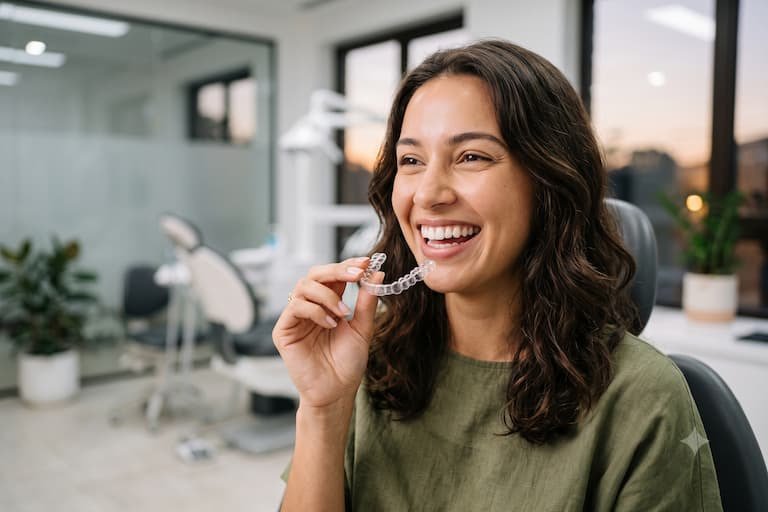
Invisalign is one of the most widely recognised names in modern orthodontics, but many adults considering it still aren’t entirely sure what it involves beyond “clear braces.” Understanding what Invisalign actually is — the material it’s made from, how it moves teeth, and what the day-to-day process looks like — is the first step in deciding whether it’s the right option for you. This guide explains the science behind Invisalign, walks through the full treatment process and realistic timelines, and covers suitability, costs, and aftercare, so you can have an informed conversation with a dental clinician.
Invisalign is a system of clear, removable aligners used to gradually straighten teeth as an alternative to traditional metal braces. Made from a flexible thermoplastic material, each aligner applies gentle, controlled pressure to specific teeth, guiding them into a new position over a series of custom-made trays, typically worn in sequence over several months.
What Is Invisalign?
Invisalign is a brand of clear aligner orthodontic treatment that uses a series of custom, removable, transparent trays to gradually move teeth into a straighter position, offering a discreet alternative to fixed metal braces.
- A form of clear aligner therapy, not a fixed brace.
- Trays are custom-made for each patient using digital scanning.
- Designed to be far less visible than traditional braces.
Invisalign belongs to a broader category of removable, transparent orthodontic aligners sometimes referred to generically as invisible braces. Unlike fixed braces, which use brackets and wires bonded to the teeth, Invisalign aligners can be taken out for eating, brushing, and flossing, which is part of why many adults find the system appealing. Many patients also consider Invisalign as one part of a wider plan for improving overall smile appearance, alongside straightening, and readers interested in how Invisalign fits within the wider landscape of options may find our cosmetic dentistry overview a useful starting point before comparing specific treatments.
How Does It Work?
Invisalign works by applying gentle, controlled force through a series of aligners, each slightly different from the last, that gradually shift teeth toward a predetermined final position mapped out digitally before treatment begins.
Key Takeaways:
- Each aligner is worn for one to two weeks before progressing to the next.
- Tooth movement relies on a biological process called bone remodelling.
- Digital treatment planning (ClinCheck) maps the entire journey before it starts.
Teeth move because of a natural biological process: when gentle, sustained pressure is applied to a tooth, the bone on one side is gradually broken down (resorption) while new bone forms on the other side (deposition), allowing the tooth to shift position over time. Invisalign aligners are engineered to apply calibrated pressure to specific teeth at specific stages, following a digital plan created from a 3D scan of the patient’s mouth. This plan, generated using ClinCheck software, previews the intended final result and the movement pathway before any aligners are made.
What Is Invisalign Made Of?
Invisalign aligners are made from a proprietary flexible thermoplastic material called SmartTrack, designed to apply continuous, gentle force to teeth while remaining comfortable, close-fitting, and largely transparent.
- SmartTrack material is multilayer and medical-grade plastic.
- Designed for a close, consistent fit that maintains steady pressure.
- More flexible than earlier generations of aligner material, reducing pressure spikes.
The material itself is a key part of how Invisalign functions clinically. SmartTrack is engineered to apply more consistent, gentler force across the treatment period compared with earlier rigid aligner materials, which can reduce discomfort while still reliably moving teeth. This is one of the less-discussed reasons Invisalign has become a leading clear aligner brand — the biomechanics of the material itself, not just the clear appearance, are central to how predictably it moves teeth.
Who Is Invisalign Suitable For?
Invisalign is generally suitable for adults and teenagers with mild to moderate crowding, spacing, crossbite, overbite, or underbite, though suitability depends on individual case complexity and should be assessed by a dental clinician.
Key Takeaways:
- Commonly used for crowding, spacing, and certain bite misalignments.
- Compliance-dependent — requires consistent daily wear to work as planned.
- Not universally suitable for very complex or severe malocclusion cases.
Invisalign can address a range of alignment issues, including mild-to-moderate crowding, spacing between teeth, and certain types of crossbite, overbite, and underbite. However, adult suitability exceptions are often overlooked in general marketing: cases involving significant tooth rotation, certain vertical bite discrepancies, missing teeth requiring restorative planning, or very severe malocclusion may be better suited to traditional braces or a combination approach. Some cases also require small tooth-coloured attachments bonded to specific teeth, or interproximal reduction (IPR) — the careful removal of a small amount of enamel between teeth — to create space for movement. A dental clinician will assess suitability based on a full examination and digital scan before recommending Invisalign.
The Complete Invisalign Process
The Invisalign process begins with a consultation and digital scan, followed by a personalised digital treatment plan, manufacture of custom aligner trays, a series of fittings as treatment progresses, and finishes with retainers to maintain the new tooth position.
Key Takeaways:
- Starts with a consultation and suitability assessment.
- Uses digital scanning rather than traditional physical impressions in most cases.
- Ends with a retention phase to prevent relapse.
The process typically unfolds as follows: an initial consultation to assess suitability and discuss goals; a digital scan of the teeth and bite; creation of a digital treatment plan showing the projected movement and final result; manufacture of a full series of custom aligners; a schedule of check-ups to monitor progress and, where needed, fit attachments or carry out IPR; and finally, transition to a retainer once the active movement phase is complete.
Step-by-Step Invisalign Treatment Timeline
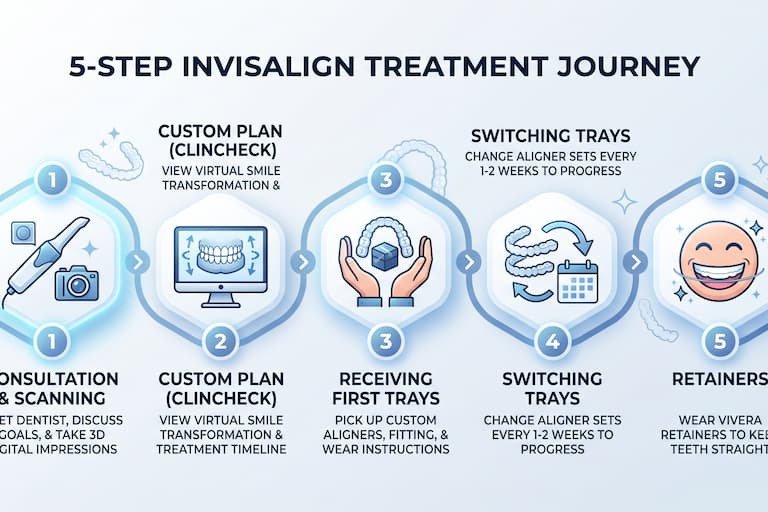
A typical Invisalign timeline includes an initial consultation and scan, digital plan approval, aligner manufacture (often a few weeks), an active wear phase of several months with periodic check-ups, and a final retention phase using retainers to hold the result.
Key Takeaways:
- Manufacturing typically takes several weeks after the plan is approved.
- Check-ups are usually spaced several weeks apart during active treatment.
- Retainers are needed indefinitely, or as long as the patient wants to preserve results.
| Stage | What Happens | Approximate Timing |
|---|---|---|
| Consultation & scan | Suitability assessed, digital scan taken | Day 1 |
| Digital plan (ClinCheck) | Treatment plan reviewed and approved | 1–2 weeks |
| Aligner manufacture | Custom aligner series produced | 2–4 weeks |
| Active treatment | Aligners worn in sequence, periodic check-ups | Several months (case-dependent) |
| Refinements (if needed) | Additional aligners for fine-tuning | 4–8 weeks, where required |
| Retention phase | Retainers worn to maintain result | Ongoing |
How Long Does Invisalign Treatment Take?
Invisalign treatment duration varies considerably by case complexity, but many adult cases fall within a range of several months to around a year, with simpler cases potentially shorter and more complex cases taking longer.
Key Takeaways:
- Duration depends heavily on how much movement is required.
- Simpler cosmetic-only cases tend to be faster than full bite corrections.
- A dental clinician can give a case-specific estimate after assessment.
| Case Complexity | Typical Duration Range |
|---|---|
| Mild crowding/spacing (cosmetic-focused) | Several months |
| Moderate crowding or bite correction | Around 6–12 months |
| Complex cases (significant bite correction) | 12 months or longer |
What Affects Invisalign Treatment Duration?
Treatment duration is affected by the complexity of the case, how closely aligners are worn to the recommended schedule, whether refinements are needed partway through, and individual biological variation in how quickly teeth respond to pressure.
Key Takeaways:
- Compliance (wear time) is one of the most significant, and most controllable, factors.
- Refinement aligners can extend the overall timeline.
- Biological response to tooth movement varies between individuals.
A frequently underappreciated point is that patient compliance often matters as much as the treatment plan itself. Aligners are generally recommended to be worn for around 20–22 hours per day; inconsistent wear can slow progress, cause aligners to fit poorly, or require additional refinement trays, extending the overall timeline beyond what was originally planned. This is one of the most common — and avoidable — reasons treatment takes longer than expected.
Invisalign Benefits
Invisalign’s main benefits include a discreet, largely transparent appearance, the ability to remove aligners for eating and cleaning, generally fewer dietary restrictions than fixed braces, and a digitally previewed treatment plan.
Key Takeaways:
- Less visible than traditional metal braces.
- Removable for eating, brushing, and flossing.
- Digital preview allows patients to see an approximate projected outcome in advance.
Invisalign Limitations
Invisalign’s limitations include a reliance on patient compliance to work effectively, unsuitability for some complex bite cases, the need to remove aligners before eating or drinking anything but water, and a cost that can be a barrier for some patients.
Key Takeaways:
- Requires discipline with wear time to stay on track.
- Not appropriate for all types or severities of malocclusion.
- Aligners must be removed before eating, unlike fixed braces.
Invisalign vs Traditional Braces
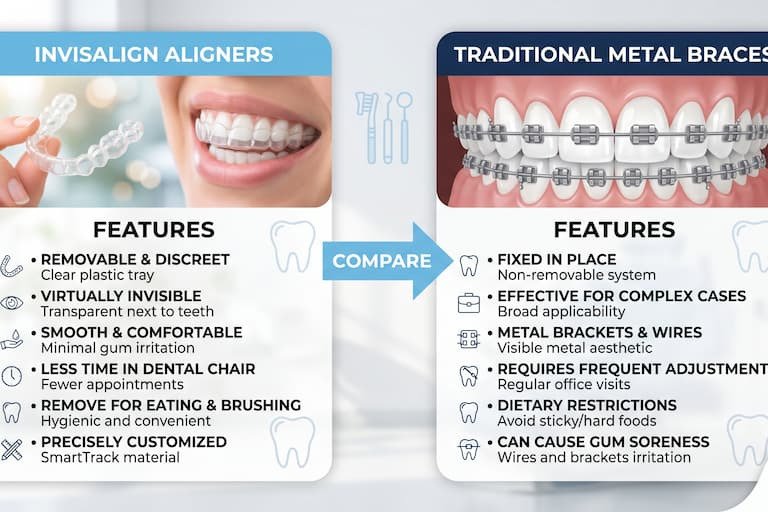
Invisalign offers a more discreet, removable alternative to traditional braces, but braces may be better suited to more complex bite corrections and do not rely on patient compliance in the same way, since they cannot be removed by the patient.
Key Takeaways:
- Braces are fixed and cannot be forgotten or removed by the patient.
- Invisalign offers more flexibility around eating and cleaning.
- Case complexity often determines which option a clinician recommends.
| Factor | Invisalign | Traditional Braces |
|---|---|---|
| Visibility | Discreet, largely transparent | Visible metal or ceramic brackets |
| Removability | Removable by the patient | Fixed, not removable |
| Compliance dependency | High — requires consistent wear | Low — works regardless of patient removal |
| Suitability | Mild to moderate cases (typically) | Suitable for a wider range of complexity |
| Eating restrictions | Removed before eating; fewer food restrictions | Some foods to avoid due to fixed brackets |
| Cleaning | Aligners and teeth cleaned separately | Requires cleaning around brackets and wires |
Best Clear Aligners for Adults
Invisalign is one of several clear aligner systems available to adults, and while it is among the most established and widely used brands, suitability between systems depends on case complexity, treatment goals, and an individual clinical assessment rather than brand alone.
Key Takeaways:
- Several clear aligner brands exist beyond Invisalign.
- Material, tracking technology, and treatment planning software vary by brand.
- A GDC-registered dental clinician can advise which system suits a specific case.
Best Invisible Braces for Adults
“Invisible braces” is a broader term covering clear aligners like Invisalign as well as certain discreet fixed options; for most adults seeking minimal visibility with removability, clear aligner systems are typically the most commonly recommended starting point, subject to suitability assessment.
Key Takeaways:
- The term “invisible braces” often refers to clear aligners generally.
- Some discreet fixed brace options also exist for more complex cases.
- The right choice depends on case complexity, lifestyle, and clinician recommendation.
Patients exploring options beyond aligners as part of a wider smile plan may also want to review how composite bonding compares with composite veneers, since orthodontic alignment and cosmetic restoration are sometimes used together, or how porcelain veneers work as an alternative approach to improving tooth appearance.
Invisalign Cost Factors
Invisalign cost varies based on case complexity, the number of aligners required, treatment duration, geographic location of the provider, and whether additional procedures such as attachments or refinements are needed.
Key Takeaways:
- More complex cases generally require more aligners and cost more.
- Provider location and experience can affect pricing.
- Refinement aligners, if needed, may add to overall cost.
| Cost Factor | How It Affects Price |
|---|---|
| Case complexity | More movement required = more aligners = higher cost |
| Number of aligners | Directly linked to treatment length and complexity |
| Geographic location | Provider fees vary by region and practice overheads |
| Refinements | Additional aligners for fine-tuning add to total cost |
| Retainers | Post-treatment retainers may be a separate cost |
A dental clinician can provide a personalised quote after assessing a specific case; because pricing varies significantly by complexity and provider, this article focuses on the general factors that influence cost rather than fixed figures.
Looking After Invisalign Aligners
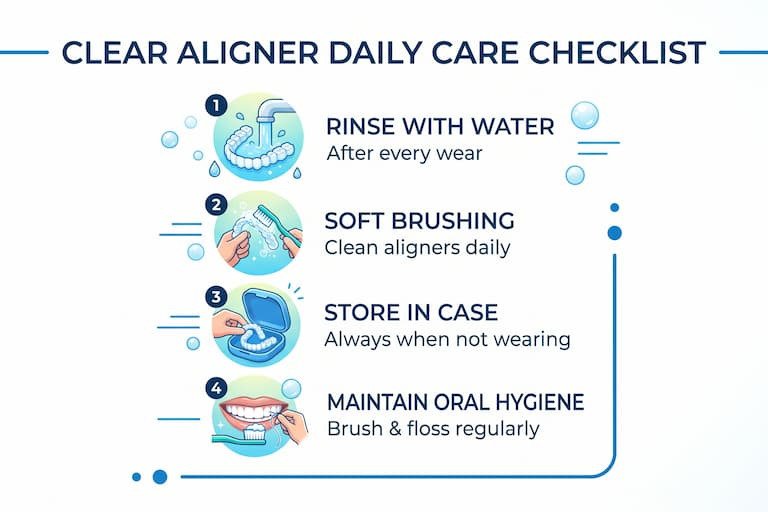
Looking after Invisalign aligners involves cleaning them regularly with a soft brush and lukewarm water, avoiding hot drinks or coloured liquids while wearing them, storing them in their case when removed, and maintaining thorough oral hygiene underneath them.
Key Takeaways:
- Clean aligners daily to prevent bacterial build-up and odour.
- Avoid eating or drinking anything but water while wearing them.
- Store aligners safely when not in use to avoid loss or damage.
Good aligner hygiene matters not only for the aligners themselves but for oral health more broadly, since aligners sit closely against the teeth and gums for most of the day. Consistent cleaning also protects the results once treatment is complete.
Common Mistakes to Avoid
Common mistakes during Invisalign treatment include not wearing aligners for the recommended hours per day, skipping check-up appointments, losing or damaging aligners, and neglecting oral hygiene underneath the trays.
Key Takeaways:
- Under-wearing aligners is the most common cause of delayed progress.
- Missing check-ups can allow issues to go unnoticed for longer.
- Poor hygiene under aligners increases decay and gum disease risk.
Because aligners cover the teeth for most of the day, food debris and bacteria can become trapped against the tooth surface if oral hygiene isn’t kept up — making consistent brushing and interdental cleaning during treatment particularly important.
For patients considering how orthodontic alignment fits alongside other cosmetic treatments, our guide to composite bonding as an alternative smile enhancement treatment outlines another commonly considered option for refining tooth shape once alignment goals are met.
Conclusion
Invisalign offers a discreet, removable approach to straightening teeth, built on a well-established digital planning process and a flexible aligner material designed to move teeth predictably over time. It suits many adult cases well, particularly mild to moderate crowding, spacing, and certain bite issues, though it isn’t the right fit for every case — and its success depends heavily on consistent daily wear. If you’re considering Invisalign, a consultation with a GDC-registered dental clinician is the best next step to assess your suitability and get a personalised treatment plan. For those weighing up their full range of options, our guide to a complete smile makeover covers how orthodontics and cosmetic treatments can work together as part of a broader plan.
Candidate Suitability Table
(Included inline above: Treatment Timeline, Duration by Complexity, Invisalign vs Braces Comparison, Cost Factors.)
| Suitable For | Less Suitable / Requires Further Assessment |
|---|---|
| Mild to moderate crowding | Severe crowding or rotation |
| Spacing between teeth | Significant vertical bite discrepancies |
| Mild-to-moderate crossbite | Complex malocclusion requiring surgical input |
| Mild overbite or underbite | Cases with multiple missing teeth needing restorative planning |
| Patients able to commit to consistent daily wear | Patients unlikely to maintain compliance |
7. Frequently Asked Questions
1. Can Invisalign fix an overbite completely?
Invisalign can improve many mild to moderate overbites, but the extent of correction depends on the severity and underlying cause of the bite issue. A dental clinician can assess whether Invisalign alone is sufficient or whether additional treatment is needed.
2. Do I need to wear a retainer forever after Invisalign?
Most clinicians recommend wearing a retainer indefinitely, at least part-time, to prevent teeth gradually shifting back toward their original position. This is a normal and expected part of long-term maintenance after any orthodontic treatment.
3. Can I drink coffee or tea with Invisalign aligners in?
It’s generally recommended to remove aligners before drinking anything other than water, as hot drinks can warp the aligner material and coloured drinks like coffee or tea can stain it.
4. Will Invisalign affect my speech?
Some people notice a temporary lisp or speech change during the first few days of wearing a new aligner, which typically resolves as the tongue adjusts to the aligner’s presence.
5. Can Invisalign be used alongside other cosmetic dental treatments?
Yes, in many cases Invisalign is used to align teeth before other cosmetic treatments, such as bonding or veneers, are carried out, allowing the final cosmetic result to be built on a well-aligned foundation.
6. What happens if I lose an aligner partway through treatment?
Contact your dental clinician promptly, as they may advise wearing the previous or next aligner in the sequence temporarily while a replacement is arranged, to avoid delaying treatment.
7. Is Invisalign painful?
Most patients experience mild pressure or discomfort for a few days after starting a new aligner, which is generally milder than the discomfort associated with tightening traditional braces, though individual experiences vary.
8. Can teenagers use Invisalign, or is it only for adults?
Certain Invisalign systems are designed specifically for teenagers, with features to accommodate growing teeth and compliance tracking, though suitability should still be assessed individually by a clinician.
9. How often do I need check-up appointments during treatment?
Check-ups are typically scheduled every several weeks during active treatment, allowing the clinician to monitor progress and address any fit or tracking issues early.
10. Can Invisalign treatment be sped up?
Treatment pace is primarily determined by biological tooth movement and the treatment plan; consistently wearing aligners for the recommended hours is the main factor within a patient’s control to keep treatment on schedule.
Clinical Disclaimer
This article is intended for general educational purposes and does not constitute personal dental or orthodontic advice. Individual suitability for Invisalign or any orthodontic treatment can only be determined through an in-person assessment by a GDC-registered dental clinician. Treatment outcomes, timelines, and costs vary between individuals and are not guaranteed. If you experience severe pain, facial swelling, or difficulty eating or speaking that does not improve, contact your dental clinician, or NHS 111/A&E if symptoms are severe. Content has been prepared with reference to current UK dental guidance and evidence hierarchy (NHS, NICE, GDC, and peer-reviewed literature) and is clinically reviewed against current UK dental guidance.
