


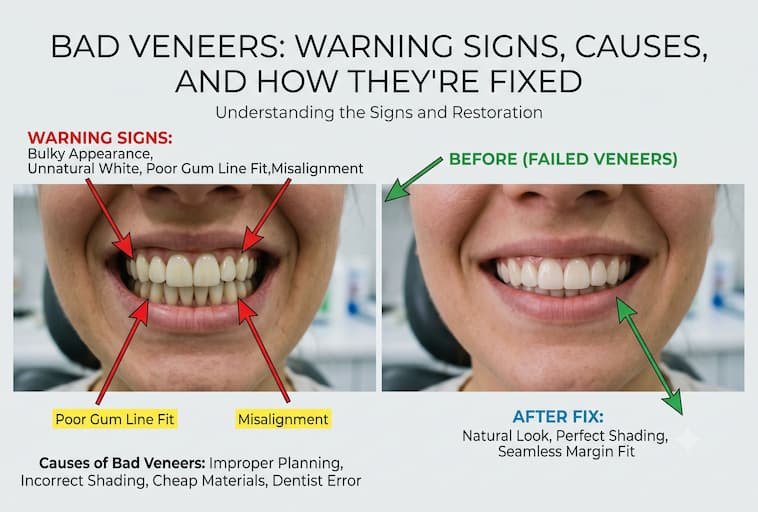
Veneers are generally a safe, well-established cosmetic dental treatment, but bad veneers can occur when preparation, shade selection, fit, or aftercare falls short of a good clinical standard. Understanding what goes wrong, and why, helps set realistic expectations before treatment and supports early recognition if something isn’t right.
Bad veneers typically show as an unnatural shape or shade, visible gum irritation, a poor fit that traps food or affects speech, or premature chipping and debonding. Most of these issues stem from inadequate planning, preparation, or aftercare rather than a fault with veneers as a treatment in general.
What Counts as “Bad Veneers”?
“Bad veneers” describes a veneer result that looks unnatural, fits poorly, or causes ongoing discomfort or gum problems, rather than any single specific defect. The term covers a range of issues from purely cosmetic mismatches to functional complications requiring correction.
- Cosmetic issues include an overly bulky shape, unnatural shine, or a shade that doesn’t suit the patient’s face.
- Functional issues include poor fit, bite problems, or difficulty speaking clearly.
- Health-related issues include gum irritation, inflammation, or recession around the veneer margin.
Distinguishing between a purely aesthetic mismatch and a genuine clinical problem matters, because the correction approach differs significantly between the two. A dental clinician assessing bad veneers teeth will typically check both the visual result and the health of the surrounding gum tissue before recommending next steps.
Signs of Bad Veneers to Look Out For
Common signs of bad veneers include an unnaturally bulky or “horse tooth” shape, a shade that looks too flat or opaque compared with natural teeth, visible gaps or overhangs at the gumline, and ongoing sensitivity or gum soreness weeks after fitting.
- Persistent gum redness, bleeding, or soreness around the veneer margin.
- A shape that looks noticeably larger, flatter, or more uniform than the patient’s natural smile.
- Visible cement lines, gaps, or rough edges when running a tongue along the teeth.
- Difficulty biting comfortably or a change in how words are pronounced.
Some of these signs, such as mild gum sensitivity, can be a normal short-term response to preparation and settle within a couple of weeks. Symptoms that persist beyond this, worsen, or are accompanied by pain should be reviewed by a dental clinician promptly. Readers considering veneers for the first time may find it useful to review dental veneers from fitting to maintenance to understand what a well-managed process should involve.
Bad Veneers vs Good Veneers: What’s the Difference?
The core difference between bad veneers and good veneers lies in proportion, shade matching, and gum health: good veneers look proportionate to the face and blend naturally at the gumline, while bad veneers often appear uniformly white, oversized, or poorly fitted at the margin.
- Good veneers are shade-matched to complement, not simply maximise, whiteness.
- Good veneers follow the natural contour of the gumline rather than sitting awkwardly on top of it.
- Good veneers allow comfortable biting and normal speech within a short adjustment period.
This comparison highlights that a “good” result is defined by natural proportion and fit rather than pure brightness. Readers weighing bad veneers vs good veneers as search terms are often really asking how to choose a treatment plan that avoids an artificial-looking outcome, which starts with a thorough consultation and realistic shade planning. For a broader look at veneer types and what influences the result, see dental veneers: types, costs, durability, pros and cons.
Bad Veneers Before and After: What Typically Goes Wrong
A bad veneers before and after result usually shows a shift from natural, individually shaped teeth to a flat, uniformly white block-like appearance, sometimes accompanied by visible margins or an altered bite alignment in the “after” image. This contrast is often used to illustrate poor planning or execution.
- Over-preparation of the natural tooth can leave insufficient structure for a well-fitted veneer.
- Rushed shade selection without accounting for lighting or skin tone often produces an overly bright, flat result.
- Inadequate follow-up appointments can mean fit issues are never corrected after initial placement.
Comparing before and after images critically, rather than assuming any dramatic change is inherently good, can help set realistic expectations. A structured consultation process, including a trial smile or mock-up where available, reduces the likelihood of this kind of outcome.
Why “Bad Veneers Celebrity” Photos Circulate Online
Photos labelled as bad veneers celebrity results circulate widely because dramatic, close-up images attract attention, though many such photos are affected by lighting, camera flash, or editing rather than reflecting the veneers’ true in-person appearance. Some also show older veneer technology or techniques no longer commonly used.
- Flash photography can make veneers appear more opaque or artificial than they look in natural light.
- Veneer materials and techniques have evolved considerably, and older results are not representative of current standards.
- Speculating about a specific named individual’s dental history isn’t something this article addresses, in line with a balanced, non-promotional educational approach.
The more useful takeaway from “gone wrong celebrities with veneers” searches is not about any particular person, but the general principle that photography conditions and outdated techniques can distort perceptions of what a modern, well-planned veneer result looks like.
Botched Veneers: Common Causes and Contributing Factors
Botched veneers are most often the result of insufficient planning, inadequate tooth preparation, or a mismatch between the patient’s expectations and what was clinically communicated before treatment, rather than a flaw in veneers as a material or technique.
- Insufficient diagnostic planning, such as skipping a trial smile or detailed shade assessment.
- Poor bonding technique leading to premature debonding or visible gaps.
- Lack of clear communication about achievable shape and shade before treatment begins.
- Inadequate aftercare guidance, increasing the risk of chipping or gum irritation.
Choosing a dental clinician who takes time for thorough assessment and planning is one of the most effective ways to reduce the risk of a botched result. Readers comparing veneers with a more conservative alternative may find it helpful to review composite bonding vs composite veneers: which option is best for your smile.
Can Bad Veneers Be Corrected?
Bad veneers can often be corrected, with options ranging from minor polishing or gum-line adjustment to full replacement, depending on whether the problem is primarily cosmetic or involves the underlying tooth or gum health. A dental clinician’s assessment determines which route is appropriate.
- Minor shape or polish adjustments can sometimes resolve mild cosmetic concerns without replacement.
- Significant shade, fit, or gum health issues generally require full veneer replacement.
- A second opinion from another dental clinician can help clarify options if a patient is unsure about their current result.
Correction timelines and suitability vary by individual case, and a thorough reassessment — including checking the health of the underlying tooth — is typically the first step before deciding on a treatment plan. For an overview of alternatives that may suit a correction plan, see veneers or lumineers: key differences you should know and composite bonding vs composite veneers: which treatment is best for you.
Bad Veneers vs Good Veneers: A Quick Comparison
| Feature | Bad Veneers | Good Veneers |
|---|---|---|
| Shape | Bulky, flat, “block-like” | Proportionate to face and natural teeth |
| Shade | Uniformly opaque white | Shade-matched, natural-looking |
| Gumline fit | Visible gaps, irritation | Follows natural gum contour |
| Bite/speech | May feel uncomfortable or affect speech | Comfortable within a short adjustment period |
| Longevity | Prone to early chipping or debonding | Durable with proper care and follow-up |
| Planning process | Rushed, minimal consultation | Thorough consultation, shade trial, clear communication |
Individual outcomes vary based on assessment, technique and aftercare; the comparison above reflects general patterns rather than guaranteed results.
FAQ Section
Are bad veneers photos online always representative of the actual in-person result?
Not always — flash photography, close-up zoom, and lighting conditions can exaggerate opacity or unevenness that is far less noticeable in person or on camera. Some widely shared photos also show outdated materials or techniques.
Can really bad veneers be removed completely rather than replaced?
In some cases, veneers can be removed, but because veneer preparation involves removing a small amount of natural tooth enamel, full removal without any replacement is not always advisable. A dental clinician can assess whether removal, replacement, or an alternative restoration is most suitable.
How soon after fitting would signs of bad veneers appear?
Fit or shade issues are usually noticeable within the first few days, while gum-related problems may take a couple of weeks to fully settle or become apparent. Any concerns noticed at the fitting appointment should be raised immediately rather than waiting.
Do bad veneers always mean the dentist made a mistake?
Not necessarily — some poor outcomes stem from unclear communication about expectations rather than technical error, though inadequate planning or preparation can also be a contributing factor. A thorough consultation process reduces this risk considerably.
Is it common for bad veneers before and after photos to involve more than one veneer treatment? Yes, some correction cases involve replacing veneers that were placed some years earlier using older materials or techniques, which can make the “before” image appear more dated than a typical modern first-time result. This is different from a single failed treatment.
Can botched bad veneers affect natural teeth permanently?
Veneer preparation involves removing a thin layer of enamel, which does not regenerate, so correction options are generally limited to replacement veneers or alternative restorations rather than returning to completely untouched natural teeth. This is a normal consideration with any veneer treatment, not unique to botched cases.
What should I ask before treatment to avoid ending up with bad veneers teeth?
Useful questions include asking to see a shade trial or mock-up, understanding the clinician’s experience with veneers specifically, and clarifying the aftercare and review process included in treatment. Clear answers to these questions are generally a good sign of thorough planning.
Are bad veneers vs good veneers differences mostly about materials, or about the dentist’s skill? Both play a role — material choice affects durability and light reflection, but shade selection, preparation, and fit depend heavily on clinical skill and planning. Choosing an experienced clinician and a considered treatment plan matters as much as the material used.
Clinical Disclaimer
This article is provided for general educational purposes only and does not constitute personalised dental advice. Individual suitability for any cosmetic or restorative dental treatment, and assessment of an existing veneer result, should be carried out by a registered dental clinician. If you experience symptoms such as high fever, facial swelling spreading toward the eye or neck, or difficulty swallowing, contact NHS 111 or attend an Accident & Emergency (A&E) department immediately.
