

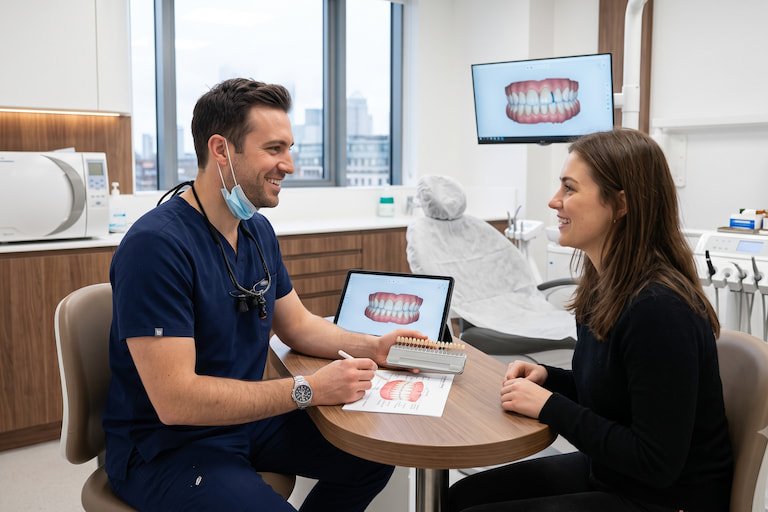
In the UK, there is a constant curiosity between the costs associated with composite bonding and the actual value of this procedure. In addition to being a middle ground (between matrix fillings and original veneers) in terms of their cost, the cost of composite bonding per tooth varies widely depending on where you are located. A patient could pay £220 to repair a chip in his or her tooth, or they could pay as much as £400 on Harley Street and there is no apparent reason for that cost variation other than the fact that it is the dentist’s price.
The only thing that can be said with certainty regarding the prices of composite bonding, is that the bottom line for composite bonding in the UK is £100 to £400 per tooth, with edge bonding (to repair chip and minor imperfections) typically costing £100 to £200; and full composite veneers costing £250 to £400 per tooth. However, these prices do not give you any insight as to what you are actually paying for, nor do they explain why the price quoted to you for composite bonding by a dentist might be nearly twice the price quoted to you by another dentist just the next day.
The cost of the material used in composite bonding is between £30 and £50 per syringe, which would cover enough material for 2 to 3 teeth. The average time it takes a dentist to complete the composite bonding procedure is 30 to 60 minutes per tooth. So you can see how composite bonding can be an extremely affordable dental service compared to the other types of dental services offered today. The reason for the price differences lies in the business models of contemporary cosmetic dentistry.
The Artistry Variable
Composite bonding is artistic sculpting with dental material – the dentist hand builds up a person’s tooth using composite resin placing layer upon layer to create a natural look. Therefore, two dentists who use the same materials can get completely different looking results based on their craftsmanship, experience and artistic vision.
This creates real pricing confusion. A newly qualified dentist could charge you £150 for a bonded tooth that gets the job done – in terms of creating function by fixing a chip, closing a gap, etc. – but doesn’t look natural (the result just looks like composite added to the tooth). In contrast, a cosmetic dentist could charge you £350 for a bonded tooth that looks just like natural enamel, including colour variations and surface textures that are virtually impossible to detect, even by other dentists.
The more expensive dentist is not necessarily over-charging; they have spent years refining their techniques, which many dentists may never learn. They often use multiple composite shades to create the illusion of depth and translucency within a single tooth. They have a clear understanding of how light interacts with tooth structure and they are able to replicate that behaviour in composite material. They have the ability to create a restoration that matches the adjacent teeth so perfectly that many patients will never know which tooth was treated.
However, it gets complicated because some of these dentists who charge a premium price are not necessarily the best at their craft. They use marketing to present themselves as a “cosmetic dentist” rather than through their actual skills. So, in reality, the £400 bond is probably not going to be any different than the £200 bond done by someone else. Patients cannot tell artistic skills from confident pricing without seeing previous work.
Also, the “social media effect” has intensified the confusion. Now, every dentist has to show their work on social media, including “before and after” photos. But these photos are often filtered, perfectly lit, taken at angles, etc., to present the biggest impact. What you may see as a dramatic transformation in a photo, could look relatively normal in person or under natural lighting. The bright white colour you see in a photo may be substantially less opaque in person. Social media optimisation has taken over as the main reason for the price a dentist charges for cosmetic work, as opposed to clinical excellence.
Regional Economics vs. Composite Reality
Composite bonding is not the most expensive in London; Edinburgh has the highest price. The average fee an Edinburgh cosmetic dentist charges for bonding is £300 to £450 per tooth, whereas an equivalent procedure in Kensington will run between £200 and £300. This contradicted the normal pattern of pricing in the UK where London usually commands the highest prices, but is consistent with the way that dental economics operate in Scotland.
People living in Scotland experience a lack of cosmetic dentistry due to the decreased number available compared to their population size. This absence of available cosmetic dentists creates a scarcity of suppliers compared to potential customers and results in inflated prices for services due to demand from international patients visiting Edinburgh due to the medical tourism market. In comparison, a medical cosmetic dentist can charge £400 for bonding in Edinburgh, but patients coming from European countries such as Dublin (£600), Oslo (£800) are willing to pay less than half of what they would pay in their home country for an identical procedure.
Contrarily, Manchester is home to dozens of cosmetic practices competing with one another for prices, resulting in decreased bonding costs down to £100 to £180 per tooth for the same dental procedure. Thanks to this high level of competition, Manchester has become the ‘capital’ of composite bonding service providers in the UK. However, it should not be inferred that high levels of competition equate to high levels of quality. Rather, they are the result of the volume provided by many practices supplying the area. Today, a person in the Manchester area can bond eight front teeth for the same price which may cost a person living in Edinburgh to bond just two teeth.
While Manchester’s competitive environment has created an abundance of low-cost bonding providers, this low-cost environment has created inconsistencies in the quality of the bonding services provided. A few of the practices continue to provide excellence regardless of low costs by utilising efficient methods to maximise their productivity. Unfortunately, many of the low-cost providers take shortcuts by using inferior composite material, rushing through their procedures, or hiring a new dental associate who has no experience in treating patients. Therefore, a consumer may be happy to pay £100 for a bonding procedure. However, they may ultimately incur high corrective costs associated with fixing the bonding issues at a later date.
The price of dental services in rural locations is determined by factors that are separate from prices in urban areas. A dentist located in a town within the Cotswolds may charge £250 for bonding due to limited availability of comparable services, whereas a dentist in the valleys of Wales charges £120 because of lower income levels in their area. The geographic location of each service ultimately determines the final pricing for cosmetic procedures.
The Mathematics of Shade Matching
It is easy to think that composite bonding is a straightforward concept. However, it is essential to fully understand the colour characteristics of natural tooth structure. Natural teeth are not a solid white colour; rather they consist of various shades of yellow, grey and have a translucent appearance. They also have a certain amount of internal characteristics that change the light passing through them. When trying to match this characteristic with a composite material, the time and skill required, as well as the materials needed for the procedure, are the primary factors affecting the final cost.
When performing basic bonding procedures, dentists typically use a single-shaded composite material (A2 or B1 on the dentist’s shade guide), apply it uniformly to the tooth and then shape the composite material into the appropriate form. This is only appropriate for small repairs, as function is more important than perfect matching. This is exactly what is offered by many dentists at prices ranging between £100 and £150 per tooth; in most instances, it does provide satisfactory results.
In advanced bonding procedures, where there are multiple shades of composite material (e.g. opaque dentine at the base, translucent enamel in the body of the tooth, and transparent edge – all of which provide realistic aesthetics), dentists use strategic layering of multiple materials to achieve the most realistic result. Therefore, advanced bonding procedures require three times more treatment duration and three times more composite materials than basic bonding, and this contributes to their higher price point.
Premium bonding is very much beyond that. Some cosmetic specialists will custom create a shade of composite with a palette of colours, similar to what a painter does when mixing colours, in order to suit the individual tooth colour of a person. They also use pigments to recreate internal characteristics of teeth such as creating white spots and translucent areas to mimic adjacent tooth areas. This type of custom feature can take as long as two hours per tooth and uses materials that most dentists do not carry.
When bonding multiple teeth, the shade of each tooth is compounded. Bonding only one tooth means matching the original teeth, while bonding multiple teeth requires creating an overall consistent aesthetic while maintaining the natural variations. The dentist becomes the artist who must balance the need for uniformity with creating a look that appears naturally occurring. If the dentist makes a mistake, the patient may appear to be wearing dentures. If the dentist performs correctly, the patient may not be detected as having had any dental work done.
The Question of Longevity
How long composite bonding lasts averages between three to seven years, but there is considerable variation in the actual amount of time that the composite bonding will last. For instance, if someone is a careful patient, the front tooth bonding may last up to ten years; whereas if someone who grinds their teeth receives back tooth bonding, the composite may fail after only a few months. Therefore, the value of the composite bonding procedure greatly differs based upon the individual characteristics of the person being treated.
Longevity is not determined by price. The composite used for the £400 Harley Street bonding is identical to that of the £150 Birmingham bonding, and therefore both products will show the same level of staining from coffee, chipping from hard foods, and wear from normal use over their work life. The only distinction is that the more expensive Harley Street bonding may look better initially. However, that does not equate to being more durable than the Birmingham bonding.
The longevity of composite bonding is determined by technique. For instance, adequate isolation of the tooth when placing the bonding, etching time prior to bonding, selection of the correct bonding agent, and light curing correctly will all influence the durability of the bonding. These technical things are invisible to the patient but play a large role in the differences in how long the bonding will last (three years versus ten years). Technical excellence cannot be determined by price.
It is important to take into account the replacement cycle when determining long-term cost considerations. If you calculate the average cost of bonding £200 per tooth every five years, it would equal £40 per year. If you take into account veneers (£800 per tooth and last for fifteen years), it would cost you £53 per year. If you look at dental implants (£2,000 and last for twenty-five years), that would be £80 per year. Therefore, the less expensive option today might become the more expensive option later.
Alternative Methods of Composite Bonding
It is essential to understand the pricing of bonding by comparing it to alternatives. For example, there are several methods to repair small chips and gaps in your teeth, each one of which will have different pricing and outcome implications.
Orthodontic costs average between £2,000 and 4,000 with permanent repositioning of teeth, which takes 6 to 18 months of time (as opposed to one trip for bonding). Orthodontics will also provide you with results for life if you retain them properly. Orthodontics might be a better overall value for patients under 30 who have minor crowding, as they would be paying more upfront for a treatment that provides permanent repositioning vs. the only intervention of bonding.
Porcelain veneers can be anywhere from £500 to 1,000 per tooth, last 10 to 20 years and are the most aesthetically pleasing of all treatment options. To achieve the benefits of porcelain veneers, a healthy tooth structure must be removed from the patient, so once they are done, the tooth structure is gone for good. The benefits of porcelain veneers provide consistent results regardless of who your dentist is, whereas bonding can provide very inconsistent results based on the artistry of the dentist. For patients desiring a very dramatic transformation, porcelain veneers provide a level of predictability that bonding cannot.
When a patient chooses composite veneers, the cost is typically only £250 to 400 per tooth. These are simply full-coverage bonding using the same materials and techniques as edge bonding, with a greater potential for dramatic change. Composite veneers last about 5 to 10 years and can be replaced without further removal of healthy tooth structure.
In many cases, doing nothing at all will be your lowest-cost option. Chips that are not easily visible can sometimes be ignored. Gaps that exist may give “character” to your smile. Slightly discoloured teeth may go unnoticed by everyone but you. Many times, general practice dentists profit from patients’ insecurities and composite bonding is more about addressing a patient’s psychological concerns, rather than functional issues.
Making the Choice for Composite Bonding
Balancing the immediate affordability of composite bonding against the long-term value; balancing aesthetic desires with practical considerations; balancing the advertising and marketing of composite bonding against the clinical outcome (which is not always equal to what is advertised) – all are crucial when you opt for composite bonding.
A chipped edge caused by trauma requires repair with functional bonding, which is worth the investment. Eight bonded teeth for the purpose of social media aesthetics are cosmetic augmentation; if someone’s everyday life does not match their photo filters, the outcome of the procedure may not be what was anticipated.
When looking for a dental practice, conduct thorough research; look beyond the galleries of a dentist. Ask if you can see bonding that was performed two years ago and not just pictures of the initial results. Call or email patients who have had bonding procedures to verify if it was worth it to them to have the procedure done again. Ask if the dental office does its own bonding or if they use the services of an associate.
Know what you are purchasing; if you are looking for a bonding procedure that fixes an issue, you will likely find that budget-friendly bonding procedures are adequate. If you wish for good aesthetics and decent durability, mid-range bonding may be the best option for you. If you want premium, high-end bonding artistry, it may work out to be worth the cost, depending upon who your practitioner is.
When scheduling the procedure, keep in mind that most dental offices will run specials during the months that they are not as busy (such as January after the holiday season and August after families return from vacations). You may be able to save an additional 20% on the price of the same procedure simply by booking at the right time. Some dental offices offer multiple tooth discounts, so having six teeth done will be a lower percentage of cost per tooth than having just one tooth done.
The composite bonding industry will likely see an increase in its divisions. Lower-end companies will be able to lower their prices to below £100 per tooth due to economies of scale and efficiency. At the other end of the spectrum, high-end cosmetic dental practitioners will price their product, which includes artistic talent and quality workmanship, at over £500 per tooth. The mid-range price points averaging between £200 and £300 will be at risk due to a lack of value proposition and their ability to justify their pricing for average results.
Thus, patients now find themselves with both opportunities and risks. There are outstanding, cost-effective options for those patients willing to do their research on composite bonding. However, for those patients who base their choices solely on how many followers a practice has on social media, or how convenient it is to get to the office, there are plenty of overpriced mediocre options. The real difference between being satisfied or regretting your choice is not the price you pay, but understanding what composite bonding is capable of delivering, and subsequently finding the right person to deliver it to you at a reasonable price if temporary improvement is what you seek.
In the meantime, as it stands now, if you chip your front tooth tomorrow, depending on which office you go to and who is behind the desk, the cost of repairing it will be between £95 and £450.
