


Cheap composite bonding in London can be worth considering, but only once the headline price is checked against what’s actually included — the consultation, number of teeth, materials, follow-up care, and any repair arrangements — since a low advertised figure can reflect a narrower scope of treatment rather than genuinely lower-cost value. Price alone shouldn’t be the deciding factor in choosing cosmetic dental treatment.
London composite bonding prices vary considerably between practices, and “cheap” is a relative term that only means something once it’s compared against a clear picture of what the treatment actually involves. This guide works through how to read a low-cost quote properly, what affects composite bonding treatment options in London, and how to weigh price against suitability and long-term value.
What Is Composite Bonding?
Composite bonding is a cosmetic dental treatment in which tooth-coloured composite resin is applied and shaped directly onto a tooth by the dentist to close gaps, repair chips, or adjust minor shape irregularities, usually completed in a single appointment without a dental laboratory.
Because the treatment is applied by hand at the chairside, the skill and time a dentist puts into shaping and finishing the composite has a real effect on how natural the result looks — which is one of the clearest reasons the procedure shouldn’t be evaluated on price alone. For a fuller explanation of how the treatment works, the dedicated guide to the composite bonding treatment covers this in more depth, separate from cost considerations.
How Much Does Composite Bonding Cost in London?
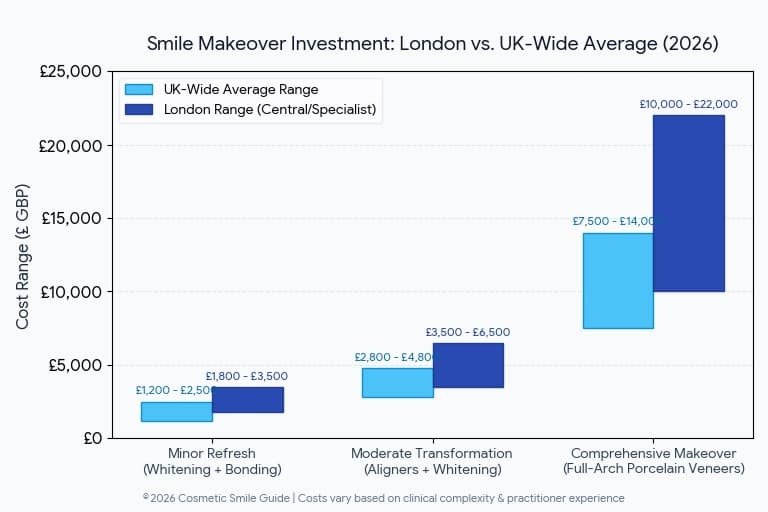
Composite bonding in London typically costs between roughly £200 and £500 per tooth, generally sitting toward the higher end of UK pricing due to higher practice overheads in the capital, with the final cost of a treatment plan depending on the number of teeth involved, the materials used, and the complexity of the work.
As with the rest of the UK, a per-tooth figure only tells part of the story — a plan involving several teeth, front-tooth aesthetic work, or a fuller smile treatment will cost more than a single minor repair, and consultation, preparation, and follow-up may or may not be included in an advertised price. Any London-specific figure quoted online should be treated as a general indication rather than a personal estimate, since only an in-person assessment can confirm an accurate total.
What Is the Cheapest Composite Bonding in London?
There’s no reliable single answer to what the “cheapest” composite bonding in London is, since advertised prices vary by what’s included, how many teeth are covered, and whether the figure reflects a genuine full treatment cost or an introductory rate for a narrower scope of work.
Two London providers advertising apparently similar prices may not be offering the same thing at all — one might include consultation, treatment, and a follow-up visit, while another covers only the composite application itself with everything else charged separately. Comparing “cheapest” fairly means asking each provider what their price actually covers before treating the headline figure as comparable at all. The guide to factors that affect composite bonding costs explains this variability in more depth.
Are Composite Bonding London Deals Worth Considering?
Composite bonding deals in London can be worth considering, but only after checking exactly what the advertised price includes — since introductory offers, package pricing, and per-tooth promotions can all present a headline figure that excludes consultation, preparation, or follow-up care that a standard quote would normally cover.
It’s reasonable to treat “deal” pricing with a degree of scrutiny rather than assuming it automatically represents better value than a standard quotation. A deal that excludes follow-up adjustments or repair cover, for instance, may end up costing more overall than a slightly higher initial quote that includes these elements from the outset. Asking directly what a promotional price excludes is usually more informative than the advertised figure itself.
What Should a Cheap Composite Bonding Price Include?
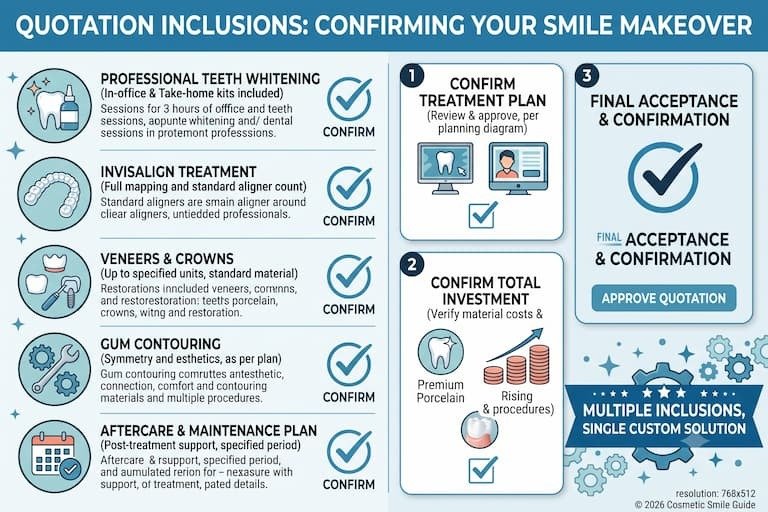
A properly itemised composite bonding price should include the consultation or examination, treatment planning, the number of teeth being treated, the composite material used, the application and shaping appointment, finishing and polishing, and ideally a follow-up review — though exactly what’s bundled together varies between providers.
Before accepting a low-cost quote, it’s worth asking specifically whether the consultation is included or charged separately, whether the price covers a single tooth or a stated number of teeth, and what happens if an adjustment or repair is needed shortly after treatment. A provider that’s transparent about these details upfront is generally a more reassuring sign than one offering only a single headline number.
Why Do Composite Bonding Prices Vary Across London?
Composite bonding prices vary across London due to differences in practice location and overheads, dentist experience, treatment complexity, the number of teeth involved, the materials and technique used, and how a given practice structures its consultation and follow-up fees.
Location within London itself can matter, with central and more affluent areas sometimes carrying higher overheads than practices further out, though this doesn’t necessarily correlate with treatment quality in either direction. A more experienced cosmetic dentist may charge more for a particular level of finishing skill, while a straightforward, less complex case will generally cost less regardless of location. None of these factors alone should be read as a reliable signal of overall quality.
Is Cheap Composite Bonding Safe?
Cheap composite bonding can be just as safe as more expensive treatment when carried out following a proper dental examination by a qualified dentist, since safety depends on clinical assessment, suitability, and technique rather than the price charged.
What actually determines safety is whether the tooth and surrounding gum are healthy enough for treatment, whether any existing decay or bite issues have been addressed first, and whether the dentist takes the time to assess the case properly rather than treating every patient identically regardless of price point. A low price is not, by itself, a safety concern — but a provider unwilling to carry out a proper assessment before treatment would be, regardless of what they charge.
What Are the Risks and Limitations of Composite Bonding?
Composite bonding carries the same general risks and limitations regardless of price, including a tendency to chip or stain over time, a shorter lifespan compared with porcelain alternatives, the need for eventual repair or replacement, and variation in how the result settles depending on bite forces and individual habits.
These limitations are inherent to the material and technique rather than a reflection of how much was paid for treatment. A well-executed lower-cost bonding treatment and a more expensive one will share the same fundamental characteristics — resin bonded to the tooth surface — so the difference in outcome, where it exists, tends to come down to the skill and time invested in shaping and finishing rather than price alone.
How Long Does Cheap Composite Bonding Last?
Cheap composite bonding can last just as long as more expensive treatment — typically around five to seven years — with longevity influenced far more by tooth location, bite forces, oral hygiene, diet, grinding habits, and ongoing maintenance than by the price originally paid for the treatment.
It’s a common assumption that a lower price must mean a shorter lifespan, but this isn’t necessarily true; the composite material and the dentist’s technique are the more significant factors. That said, a rushed treatment carried out without proper shaping and finishing — something more likely where a provider is processing a high volume of low-cost cases quickly — could genuinely affect how well the result holds up, which is why the quality of the appointment matters more than the price tag itself.
Is Composite Bonding Cheaper Than Veneers?
Composite bonding is generally less expensive than both composite and porcelain veneers, requiring little to no tooth preparation and typically completed in a single visit, whereas veneers cost more upfront but tend to last considerably longer, particularly porcelain, which can offset the higher initial price over time.
The right choice depends on what’s being addressed and how long the result needs to last, not simply which option costs less initially. Readers weighing this decision in more detail may find the comparison of differences between composite and porcelain veneers useful for understanding where each material fits.
Can Composite Bonding Be Used for a Full Smile Makeover?
Yes, composite bonding can be used across several teeth as part of a broader smile makeover, though for more significant changes to tooth proportion, alignment, or long-term durability, a dentist may recommend combining bonding with other treatments or considering veneers instead.
Where a smile makeover involves multiple concerns — colour, shape, and alignment together — bonding is often one component of a wider plan rather than the sole treatment. Readers exploring other cosmetic smile treatment options as part of a broader plan may find the guide to other cosmetic smile treatment options useful for understanding how veneers compare within that wider context.
Can Teeth Whitening Be Combined With Composite Bonding?
Yes, teeth whitening is often combined with composite bonding, and it’s generally recommended to whiten first so that any bonding can be shade-matched to the newly whitened teeth rather than the other way around, since composite resin doesn’t change colour the way natural enamel does when whitened afterwards.
This sequencing matters regardless of budget, since bonding placed before whitening can end up visibly lighter or darker than the surrounding natural teeth once whitening is completed later. Readers whose primary concern is shade rather than shape may find the guide to professional teeth whitening options useful for understanding whether whitening alone might address their concern more simply.
What Should You Check Before Choosing Cheap Composite Bonding?
Before choosing a low-cost composite bonding provider, it’s worth confirming that a proper dental assessment is included, understanding exactly how many teeth the price covers, checking what materials and technique will be used, and asking what happens if the result needs adjusting or repairing shortly after treatment.
A practical checklist: is a dental assessment included before treatment; is the price per tooth or for the full plan; how many teeth are actually covered; what composite material is being used; is treatment planning included; are follow-up appointments covered; what’s the arrangement if bonding chips soon after treatment; and is the provider transparent about the limitations of the treatment rather than presenting it as a universal fix.
Is Cheap Composite Bonding Good Value?
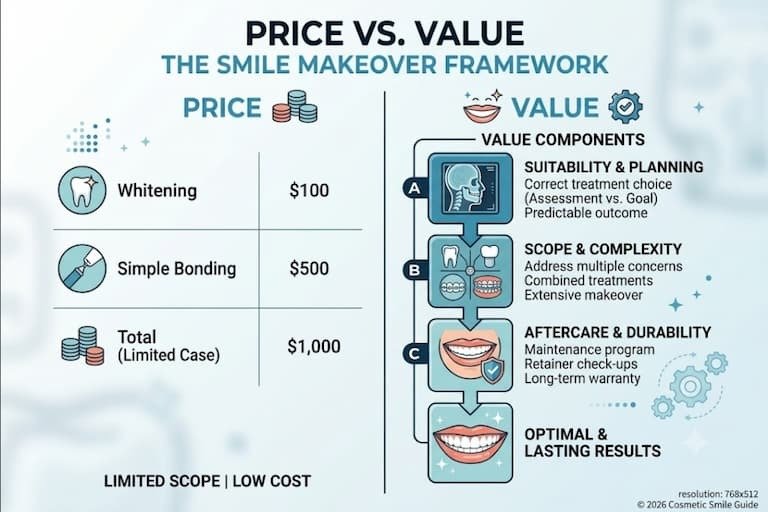
Cheap composite bonding can represent good value, but “cheap” and “good value” aren’t automatically the same thing — value depends on whether the price reflects a suitable, properly planned treatment that includes the right scope of care, not just the lowest number on the page.
A low price paired with a proper assessment, clear treatment planning, and transparent follow-up arrangements can represent excellent value. A low price that excludes consultation, skips proper oral health assessment, or leaves repairs uncovered may end up costing more overall once these gaps are addressed elsewhere. Equally, a higher price doesn’t automatically guarantee better value — it should be judged against the same criteria: suitability, scope, materials, and aftercare.
What Are the Alternatives to Cheap Composite Bonding?
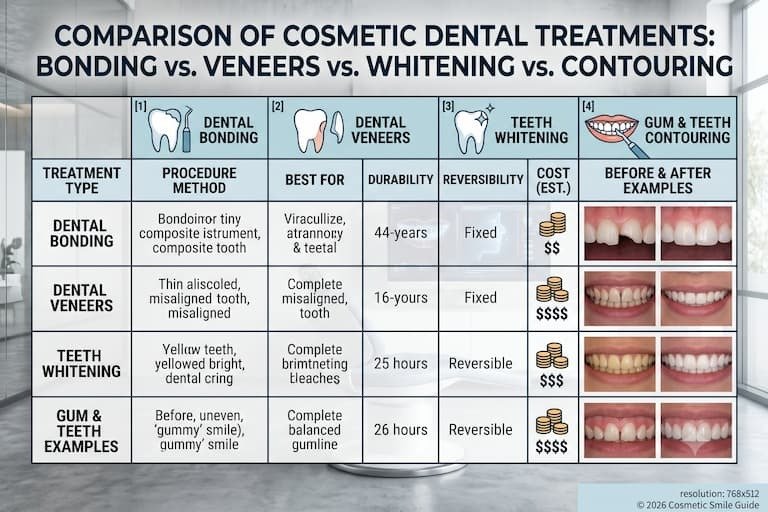
Alternatives to composite bonding include teeth whitening for shade-only concerns, composite or porcelain veneers for more significant or longer-lasting shape change, Invisalign for alignment issues, and teeth contouring for very minor shape refinements — with the right alternative depending on the specific concern rather than budget alone.
Where the concern is simply a slightly uneven edge rather than a chip or gap needing rebuilding, tooth contouring as a cosmetic option may achieve a similar visual improvement at a comparably modest cost, without adding composite material to the tooth at all. A proper assessment is the most reliable way to identify which alternative genuinely fits a specific concern.
How to Maintain Composite Bonding
Maintaining composite bonding relies on consistent oral hygiene, regular dental reviews, avoiding excessive staining foods and drinks, being mindful of hard biting, and addressing grinding habits with a night guard where relevant — none of which differs based on how much was originally paid for the treatment.
Maintenance requirements contribute meaningfully to the long-term value of the treatment, since a well-maintained lower-cost bonding treatment can outlast a poorly maintained more expensive one. This is one of the clearest reasons that ongoing care, not just the initial price, should factor into how “affordable” a treatment turns out to be over its full lifespan.
Final Decision Framework
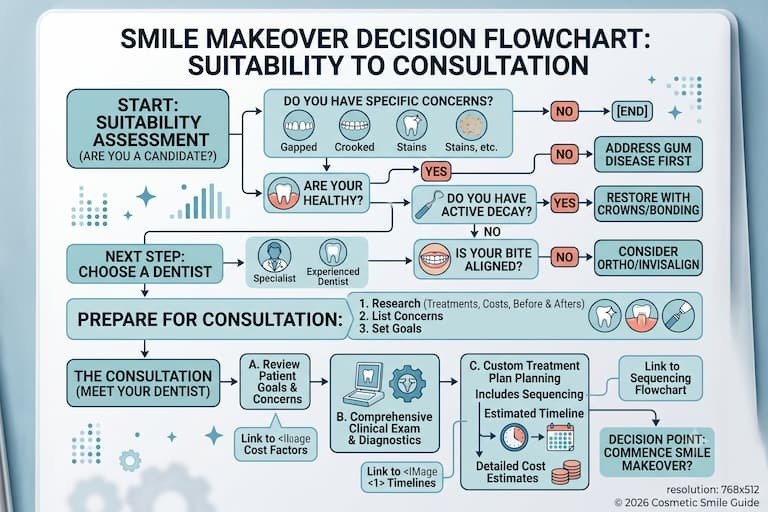
Choosing cheap composite bonding in London sensibly means starting with suitability, then comparing total treatment cost rather than a headline figure, checking exactly what’s included, considering longevity and maintenance, weighing appropriate alternatives, and discussing the specific case with a qualified dental professional before committing to any provider.
Working through these steps in order — suitability first, cost comparison second — helps avoid choosing a provider based purely on an attractive advertised price that may not reflect the actual scope of care needed. Cosmetic Smile Guide’s broader look at broader cosmetic dentistry guidance is a useful next step for readers still deciding whether composite bonding is the right category of treatment at all before comparing specific providers.
Comparison Tables
Table 1: Composite Bonding Cost Factors
| Scope | What It Typically Involves | Cost Consideration |
|---|---|---|
| Per-tooth treatment | Single tooth correction | Lower cost, but check what’s included |
| Multiple-tooth treatment | Several teeth treated together | May have a reduced per-tooth rate |
| Full smile treatment | Wider smile-zone or full-arch bonding | Higher total cost, more planning involved |
| Consultation | Initial assessment | May or may not be included in headline price |
| Additional preparation | Treating existing oral health issues first | Often priced separately |
| Follow-up | Review and minor adjustment | Should be confirmed as included or extra |
| Repair considerations | Fixing a chip after treatment | Arrangements vary significantly by provider |
Table 2: Price vs Value
| Consideration | Low Headline Price | Higher Headline Price |
|---|---|---|
| Treatment scope | May cover fewer inclusions | May include more as standard |
| Consultation | Check if included | More likely included |
| Follow-up | Check if included | More likely included |
| Longevity | Not determined by price alone | Not guaranteed by price alone |
| Overall value | Depends on what’s included and suitability | Depends on what’s included and suitability |
Table 3: Composite Bonding vs Alternatives
| Aspect | Composite Bonding | Composite Veneers | Porcelain Veneers | Teeth Whitening | Tooth Contouring |
|---|---|---|---|---|---|
| Typical UK cost | £150–£400/tooth (London often £200–£500) | £250–£600/tooth | £500–£1,200/tooth | £250–£650 | Generally lower cost, minor adjustment |
| Tooth preparation | Minimal to none | Minimal | Some enamel removal | None | Small enamel removal |
| Longevity | 5–7 years | 5–8 years | 10–15+ years | 6 months–2 years | Permanent, but limited scope |
| Best suited to | Chips, gaps, moderate shape change | Shape and shade change | Significant, long-term change | Shade only | Minor edge/shape refinement |
Frequently Asked Questions
Is cheap composite bonding in London safe?
It can be just as safe as more expensive treatment, provided it follows a proper dental assessment and is carried out by a qualified dentist; price itself is not a reliable indicator of safety.
What is the average cost of composite bonding in London?
London prices typically run somewhat higher than the UK average, often in the region of £200–£500 per tooth, though the exact cost depends on the number of teeth and complexity involved.
How much does composite bonding cost per tooth in the UK?
Across the UK, composite bonding generally costs between £150 and £400 per tooth, with London and the South East often at the higher end of this range.
Why is some composite bonding much cheaper than other treatment?
Price differences often reflect what’s included — some low-cost quotes exclude consultation, preparation, or follow-up care that a higher-priced quote may include as standard.
Are composite bonding deals worth it?
They can be, but it’s worth checking exactly what a deal or promotional price includes before assuming it represents better value than a standard quotation.
Does cheap composite bonding last?
Longevity depends mainly on the material, technique, and how well the result is maintained afterwards, rather than the price paid, so cheap bonding can last just as long as more expensive treatment when carried out properly.
Can composite bonding be repaired if it chips?
In most cases, yes — a dentist can usually repair a small chip or area of damage directly, though it’s worth confirming whether repair is included in the original quote or charged separately.
Is composite bonding cheaper than veneers?
Yes, composite bonding is generally less expensive upfront than composite or porcelain veneers, though veneers, particularly porcelain, tend to last considerably longer.
Are consultation fees included in composite bonding prices?
This varies by provider — some include the consultation in a headline price, while others charge for it separately, so it’s worth confirming before comparing quotes.
Can anyone have composite bonding?
Not necessarily — suitability depends on the condition of the tooth and surrounding gum, and existing oral health issues such as decay or gum disease may need treating first.
Clinical Disclaimer
This article is an independent educational resource from Cosmetic Smile Guide and is intended for general information only; it does not recommend or endorse any specific dentist, clinic, or provider in London. Composite bonding suitability, safety, and treatment costs vary between individuals and can only be properly assessed by a qualified dental professional following an in-person examination. Where symptoms such as pain, swelling, or injury are present, readers should seek urgent dental care or contact NHS 111 rather than pursuing cosmetic treatment.
