


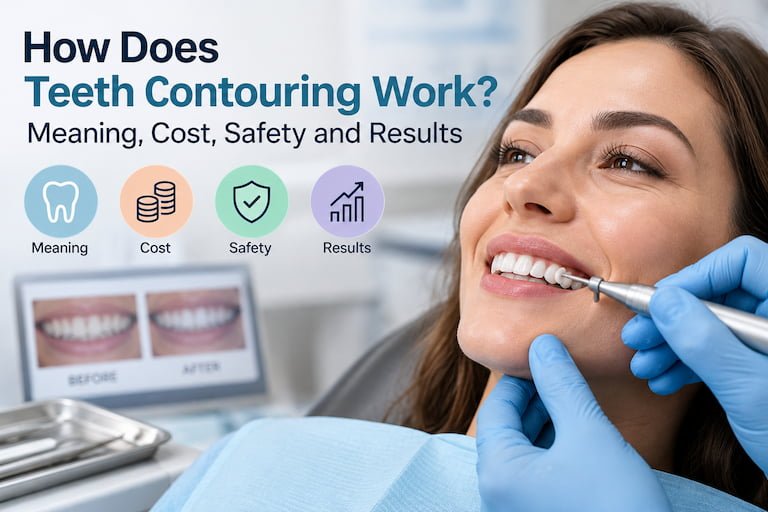
Teeth contouring is a cosmetic dental procedure that reshapes the outer enamel of a tooth — smoothing a rough edge, evening out length, or softening a pointed corner — by removing very small amounts of enamel using a fine dental drill or abrasive strip. It’s one of the least invasive cosmetic treatments available, but it only suits minor irregularities rather than significant shape change.
Because it involves removing tooth structure rather than adding to it, contouring works in the opposite direction to treatments like composite bonding or veneers, which build a tooth up rather than reduce it. That distinction matters more than it might seem, since it directly limits what contouring can and can’t achieve — a point that’s often glossed over in how the treatment gets marketed. For a wider view of how contouring sits alongside other options, cosmetic dental treatment options covers the full range of procedures this decision might draw from.
What Is Teeth Contouring?
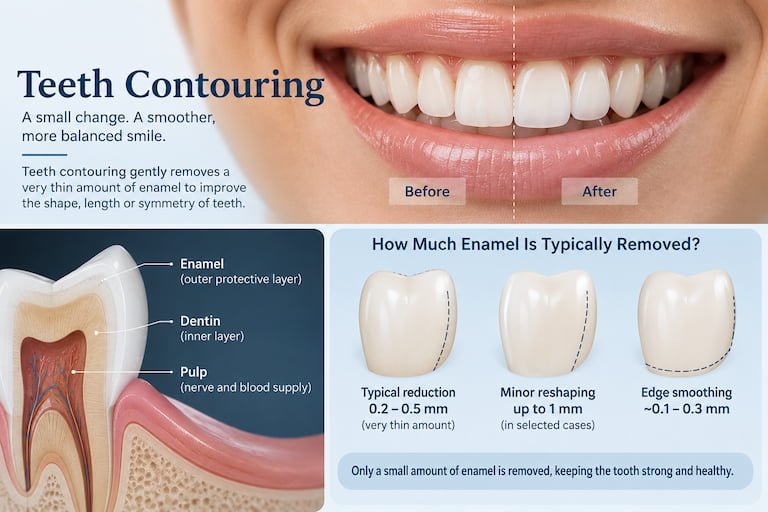
Teeth contouring, sometimes called tooth reshaping, is a cosmetic dental procedure in which a dentist removes small amounts of enamel from the surface or edge of a tooth to refine its shape, length, or texture, typically completed in a single short appointment with no anaesthetic required.
It’s used to make subtle adjustments rather than dramatic ones — smoothing a chipped corner, rounding a slightly pointed tooth, or evening out two front teeth that are marginally different lengths. Because only enamel is removed and the procedure doesn’t add any material to the tooth, the scope of what it can achieve is inherently limited by how much of the original tooth shape can be refined without compromising its strength.
What Is Tooth Contouring and Reshaping?
Tooth contouring and tooth reshaping are generally used interchangeably to describe the same cosmetic procedure, while the clinical term for it is enameloplasty — the controlled removal of enamel to alter a tooth’s shape.
The terminology can cause some confusion because “contouring” is also sometimes used loosely to describe gum contouring, which is an entirely different procedure involving soft gum tissue rather than tooth enamel. When researching teeth contouring specifically, it’s worth checking that any information or quote refers to enamel reshaping of the tooth itself, not the surrounding gum line.
Why Are Teeth Contoured?
Teeth are contoured mainly to correct minor cosmetic irregularities in shape, length, or symmetry — such as a slightly uneven edge, a small chip, a pointed corner, or one tooth appearing marginally longer than its neighbour — rather than to address larger structural or colour-related concerns.
It’s often used as a finishing step after orthodontic treatment, once teeth are already aligned but small shape differences remain visible, or alongside composite bonding to blend a new edge smoothly into the natural tooth. Because the changes achievable are genuinely minor, contouring tends to work best as a refinement tool rather than a standalone solution to a significant aesthetic concern — though it’s frequently included as one small element within a broader smile makeover plan involving several treatments together.
Can Front Teeth Be Contoured?
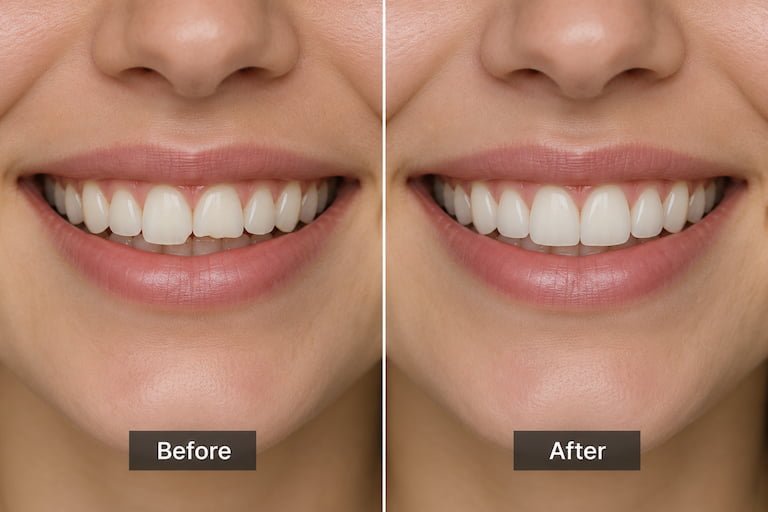
Yes, front teeth can be contoured, and this is in fact the most common application of the procedure, since minor length or edge irregularities are most noticeable on the teeth visible when smiling.
Front teeth contouring requires particular attention to symmetry, since a change to one incisor that isn’t mirrored on the other can create a new, more obvious imbalance rather than resolving the original concern. It also requires care around the bite: front teeth play a role in how the upper and lower jaw meet during certain movements, so a dentist will usually check occlusion before and after any reshaping to make sure the adjustment hasn’t affected how the teeth come together.
How Does Teeth Contouring Work?
A teeth contouring appointment typically begins with a dental examination to confirm the tooth has enough healthy enamel to work with, followed by the dentist using a fine drill, abrasive strip, or polishing disc to gradually remove small amounts of enamel while checking shape and symmetry throughout.
The process is usually gradual and reversible in the sense that a dentist can stop and reassess at any point, though the enamel already removed cannot be replaced. Because so little tooth structure is involved, the appointment is generally quick — often well under an hour — and doesn’t typically require any injection or anaesthetic, since the outer enamel layer being adjusted has no nerve sensitivity itself. The exact approach varies by case, and not every contouring appointment follows an identical sequence, particularly where it’s combined with another treatment like bonding.
Does Teeth Contouring Hurt?
Teeth contouring is generally described as painless or only mildly uncomfortable, since the procedure works on the outer enamel layer, which doesn’t contain nerve endings, and rarely requires any anaesthetic.
Some patients report mild sensitivity to temperature in the treated tooth for a short period afterwards, particularly if a larger amount of enamel was removed or the tooth was already slightly sensitive beforehand. This tends to settle within a few days. Individual experiences vary, and anyone with a history of sensitive teeth should raise this with their dentist beforehand so the amount of enamel removed can be managed accordingly.
Is Teeth Contouring Safe?
Teeth contouring is generally considered safe when carried out by a trained dental professional following a proper examination, since only a small, controlled amount of enamel is removed and the procedure doesn’t affect the tooth’s internal structure when performed correctly.
The main safety consideration is enamel thickness — enamel doesn’t regenerate once removed, so a dentist needs to judge in advance how much can be safely reshaped without exposing the underlying dentine, which is more sensitive and less protective. Contouring is not considered safe or appropriate for teeth with already thin enamel, extensive existing wear, or active decay, which is why a dental examination should always precede treatment rather than the procedure being offered without assessment.
Is Tooth Reshaping Safe for Enamel?
Tooth reshaping only remains safe for enamel when the amount removed stays well within the tooth’s healthy enamel thickness, which varies from tooth to tooth and person to person, making an individual dental examination essential before any reshaping begins.
Enamel is the hardest substance in the human body, but it’s also finite — it doesn’t repair or regrow the way some other tissues do. This is why teeth contouring is generally limited to very small adjustments; anything beyond a minor refinement risks removing enough enamel to affect the tooth’s long-term strength or expose sensitive dentine underneath. A dentist assessing suitability is essentially judging how much “margin” a tooth has before this becomes a risk.
Who Is Suitable for Teeth Contouring?
Suitable candidates for teeth contouring generally have healthy teeth with adequate enamel thickness and a minor cosmetic concern — a small chip, a slightly uneven edge, or a mildly pointed tooth corner — rather than a significant shape, colour, or alignment issue.
Teeth contouring is generally not appropriate for anyone with thin or already worn enamel, active decay, gum disease, or a concern that requires more substantial correction than enamel removal alone can achieve. In these situations, a dentist is more likely to recommend composite bonding, veneers, or orthodontic treatment instead, since these approaches can address larger changes without relying on removing an already-limited amount of enamel — a fuller sense of what falls under cosmetics in dentistry more broadly can help with understanding where each of these fits.
Teeth Contouring Before and After: What Results Can You Expect?
Realistic teeth contouring results are subtle — a smoother edge, slightly more even tooth lengths, or a softened corner — rather than a dramatic transformation, and the extent of visible change depends entirely on how significant the original irregularity was.
Before-and-after photographs used to market the treatment can sometimes create unrealistic expectations, particularly where the “before” image shows a more significant irregularity than contouring alone would typically be used to correct, or where the result shown actually involved bonding alongside contouring rather than contouring on its own. A useful way to set expectations is to think of contouring as smoothing and refining an existing tooth shape, not redesigning it.
How Much Does Teeth Contouring Cost in the UK?
Teeth contouring in the UK is generally one of the more affordable cosmetic dental treatments, with cost influenced by the number of teeth treated, the complexity of the reshaping, whether it’s combined with another treatment, and the dentist’s fee structure, rather than following a single fixed price.
As a broad guide, single-tooth contouring often falls in a lower cost bracket than composite bonding or veneers, since it typically requires less appointment time and no laboratory involvement. Where several teeth are being reshaped together, or contouring is combined with bonding to refine the finished result, the overall cost will reflect that broader treatment plan rather than the contouring element alone — the broader cosmetic dental surgery cost guide covers how these combined treatment costs tend to stack up. A dentist can only confirm an accurate cost after examining the teeth in question.
Teeth Reshaping Cost: What Can Affect the Price?
Teeth reshaping cost is mainly affected by how many teeth are involved, how much time the reshaping requires, whether it’s carried out as a standalone treatment or alongside bonding or another cosmetic procedure, and the location and fee structure of the practice.
A single, minor adjustment to one tooth is typically the lowest-cost version of this treatment, since it can often be completed within a short appointment. Multi-tooth reshaping, or cases where contouring is used to prepare or refine teeth for a subsequent bonding or veneer treatment, will cost more simply because more clinical time and planning are involved — the composite bonding cost guide breaks down a very similar set of cost factors for readers comparing the two. As with most cosmetic dentistry, practices in London and the South East tend to charge more than those elsewhere in the UK.
What Are the Benefits of Cosmetic Teeth Contouring?
The main benefit of teeth contouring is that it can visibly improve minor shape irregularities with minimal intervention, no anaesthetic, and typically no downtime, making it one of the most conservative cosmetic dental options available.
Because so little tooth structure is removed, it also carries a lower overall risk profile than treatments involving more substantial preparation, and results are immediate, without the waiting period associated with orthodontic treatment or the laboratory turnaround needed for veneers or crowns. It’s also frequently used as a low-cost finishing touch alongside another treatment, rounding off a bonding repair or smoothing an edge left slightly uneven after orthodontic treatment — in that sense it sits alongside professional teeth whitening options as one of the more conservative, lower-intervention routes in cosmetic dentistry.
What Are the Limitations and Risks?
The main limitations of teeth contouring are that it removes enamel permanently, can only correct minor irregularities, and isn’t suitable for every tooth, while risks include temporary sensitivity, the possibility of uneven results if reshaping isn’t carried out symmetrically, and the loss of a tooth’s natural protective enamel layer if too much is removed.
Because enamel doesn’t regenerate, any contouring carried out is effectively permanent, even though the procedure itself is minor. Overzealous or poorly planned reshaping can also affect how the bite feels, particularly on front teeth, which is why symmetry and occlusion checks matter throughout the process. Where a concern turns out to be more significant than contouring can safely address, a dentist will usually recommend an alternative treatment rather than attempting to achieve too much through enamel removal alone.
Teeth Contouring vs Composite Bonding
Teeth contouring removes small amounts of enamel to refine an existing tooth shape, while composite bonding adds tooth-coloured resin to the tooth to build up length, close gaps, or change shape more significantly — making the two approaches complementary rather than directly competing.
In practice, contouring suits teeth that are basically the right shape but need minor smoothing, while bonding suits teeth needing a more noticeable change in shape, length, or coverage of a chip. The two are frequently used together — contouring to smooth an edge, bonding to rebuild length — and a dentist assessing a cosmetic concern will typically consider which combination best matches what’s achievable and desired. More detail on how bonding specifically works is available in the guide to the composite bonding procedure and its benefits.
Teeth Contouring vs Dental Veneers
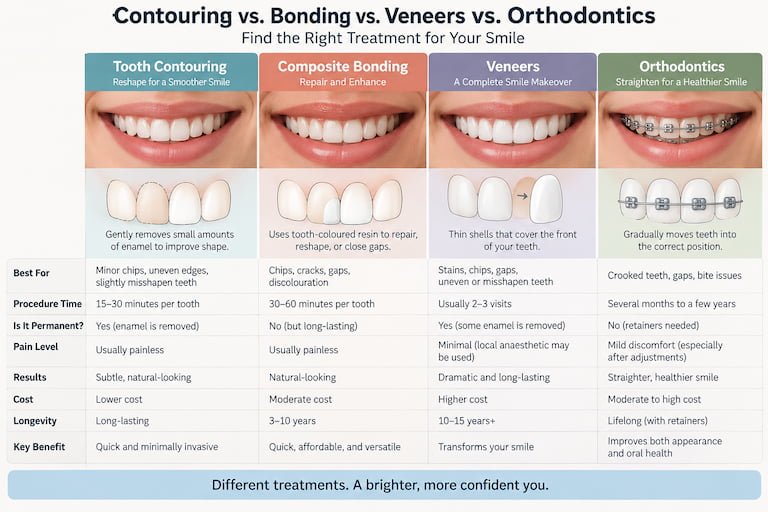
Teeth contouring removes a small amount of natural enamel to refine shape, while dental veneers involve bonding a thin porcelain or composite shell onto the front of the tooth to change its shape, shade, or size more substantially, generally requiring more tooth preparation and a longer-lasting but less reversible result.
Veneers are the more appropriate choice where the desired change goes beyond what enamel removal alone can achieve — a significant colour change, a larger shape correction, or coverage of more extensive damage. Contouring, by contrast, is limited to refinement rather than reconstruction. Readers weighing whether their concern needs the more substantial change veneers provide may find the guide to dental veneers from fitting to maintenance useful for comparison.
Teeth Contouring vs Orthodontic Treatment
Teeth contouring addresses tooth shape, while orthodontic treatment such as Invisalign addresses tooth position and alignment — meaning the two solve fundamentally different problems and are sometimes used together, with alignment typically completed first.
Where teeth are crowded, rotated, or unevenly spaced, contouring alone won’t resolve the underlying alignment issue, since it can only refine the surface shape of a tooth that’s already correctly positioned. Contouring is often used after orthodontic treatment as a finishing step, smoothing minor shape differences that become more noticeable once teeth are properly aligned — and since that sequencing means contouring usually waits until alignment is finished, how long Invisalign treatment may take is worth checking first for anyone weighing up the two together. Readers whose concern may actually be alignment rather than shape can find more detail in the guide to what Invisalign involves.
How to Choose the Right Cosmetic Dental Treatment
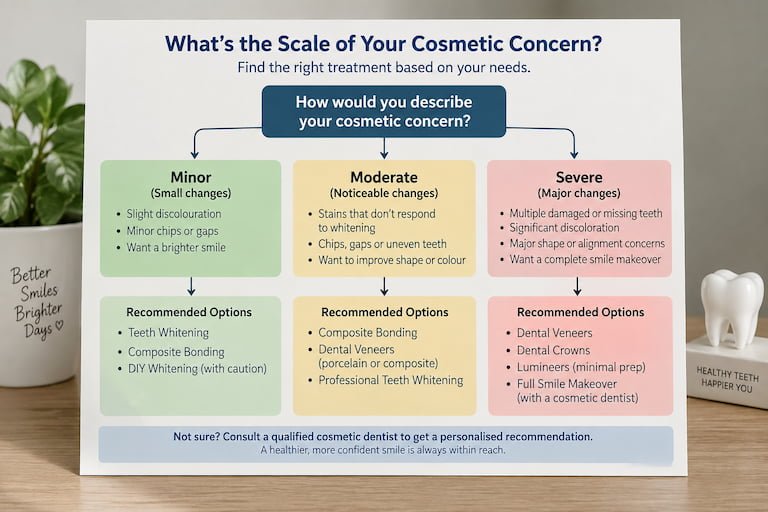
Choosing between teeth contouring and an alternative treatment depends on the scale of the change needed: minor edge or symmetry adjustments generally point toward contouring, larger shape or length changes point toward bonding or veneers, colour concerns point toward whitening, and position or spacing concerns point toward orthodontic treatment.
A useful way to approach this is to separate the specific concern from the assumed solution — rather than starting with “I want contouring,” starting with “my tooth edge is uneven” allows a dentist to recommend whichever treatment, or combination of treatments, genuinely fits the scale of that concern. Readers still working out which category their concern falls into may find it useful to compare contouring against bonding using the guide to composite bonding versus composite veneers, since the decision logic between “add material” and “remove material” treatments follows similar principles.
How to Look After Contoured Teeth
Looking after contoured teeth mainly involves standard oral hygiene — thorough brushing, interdental cleaning, and regular dental checkups — since the procedure doesn’t require any special aftercare routine beyond monitoring for sensitivity in the days following treatment.
Because contouring smooths rather than restores a tooth, there’s no repair or replacement schedule in the way there is with bonding or veneers; the change is essentially permanent unless further reshaping is carried out later. It’s still worth mentioning any contouring to a dentist at future checkups, so they’re aware of the tooth’s current enamel thickness if any further cosmetic treatment is considered in future. For a broader view of how contouring fits alongside the full range of cosmetic dental treatments, Cosmetic Smile Guide’s complete guide to cosmetic dentistry is a useful next read.
Comparison Tables
Teeth Contouring at a Glance
| Aspect | Detail |
|---|---|
| What it is | Removal of small amounts of enamel to refine tooth shape |
| Main purpose | Smoothing minor irregularities, edges, and symmetry |
| Typical application | Front teeth, minor chips, uneven edges |
| Tooth structure involved | Outer enamel only |
| Permanence | Permanent — enamel does not regenerate |
| Main limitation | Suited to minor changes only |
Table 2: Teeth Contouring vs Alternatives
| Aspect | Teeth Contouring | Composite Bonding | Veneers | Orthodontic Treatment |
|---|---|---|---|---|
| Main purpose | Refine existing shape | Rebuild/add shape | Change shape, shade, size | Correct alignment/position |
| Natural tooth alteration | Removes small amount of enamel | Adds material, minimal removal | Requires enamel removal (porcelain) | None to teeth themselves |
| Typical cosmetic scope | Minor | Moderate | Moderate to significant | Alignment only |
| Reversibility | Not reversible (permanent) | Reversible in principle | Not reversible (porcelain) | Reversible without treatment |
| Maintenance | Minimal | Moderate (chip/stain prone) | Routine checkups | Long-term retainer wear |
| Suitability | Healthy enamel, minor concern | Chips, gaps, shape change | Larger shape/shade change | Crowding, spacing, bite issues |
Cost Factors
| Factor | Effect on Price |
|---|---|
| Number of teeth treated | More teeth increases overall cost |
| Complexity of reshaping | More involved cases require more chair time |
| Combined with other treatment | Combining with bonding increases total cost |
| Practice location | Typically higher in London and the South East |
Suggested Visuals
- Diagram showing enamel layer and how much may typically be adjusted during contouring
- Front teeth symmetry illustration before and after minor reshaping
- Comparison chart: contouring vs bonding vs veneers vs orthodontics
- Simple decision flowchart based on the scale of the cosmetic concern
Frequently Asked Questions
Does teeth contouring permanently change tooth shape?
Yes — because enamel doesn’t regenerate, any shape change achieved through contouring is permanent, even though the amount of enamel removed is typically very small.
Can teeth contouring fix slightly uneven front teeth?
It often can, particularly where the unevenness is minor, such as a small difference in length or a slightly uneven edge, though more significant differences may need bonding or veneers instead.
Can tooth reshaping make teeth look shorter?
Yes, reshaping can slightly reduce the visible length of a tooth by smoothing the biting edge, though this is typically a small adjustment rather than a dramatic change.
Is enamel removed during teeth contouring?
Yes, a small, controlled amount of enamel is removed from the tooth surface or edge, which is why a dental examination beforehand is important to confirm there’s enough healthy enamel to work with.
Can teeth become sensitive after contouring?
Some mild, temporary sensitivity to temperature is possible, particularly where a larger amount of enamel was removed, and this typically settles within a few days.
Can contouring replace veneers?
Not usually — contouring can only refine an existing tooth shape, while veneers can address more significant changes to shape, shade, and size, so the two aren’t interchangeable for larger concerns.
Is teeth contouring suitable for chipped teeth?
It depends on the size of the chip — very minor chips may be smoothed through contouring alone, but larger chips typically need composite bonding to rebuild the missing tooth structure.
Can teeth contouring affect the bite?
It can if reshaping isn’t carried out carefully, which is why a dentist checks occlusion before and after treatment, particularly on front teeth involved in certain bite movements.
How long does a teeth contouring appointment take?
Most contouring appointments are relatively short, often well under an hour, since only a small amount of enamel is being adjusted and no anaesthetic is typically required.
Will I need more than one contouring appointment?
Usually not for a single minor adjustment, though a dentist may review the result at a follow-up checkup, and further contouring could be considered later if enamel thickness allows.
Clinical Disclaimer
This article is intended for general educational purposes only and should not replace personalised advice from a qualified dental professional. Suitability for teeth contouring depends on individual enamel thickness, tooth condition, and oral health, which can only be confirmed through an in-person dental examination. Where a tooth is painful, damaged, or an urgent concern, readers should seek prompt dental assessment rather than pursuing cosmetic treatment.
