


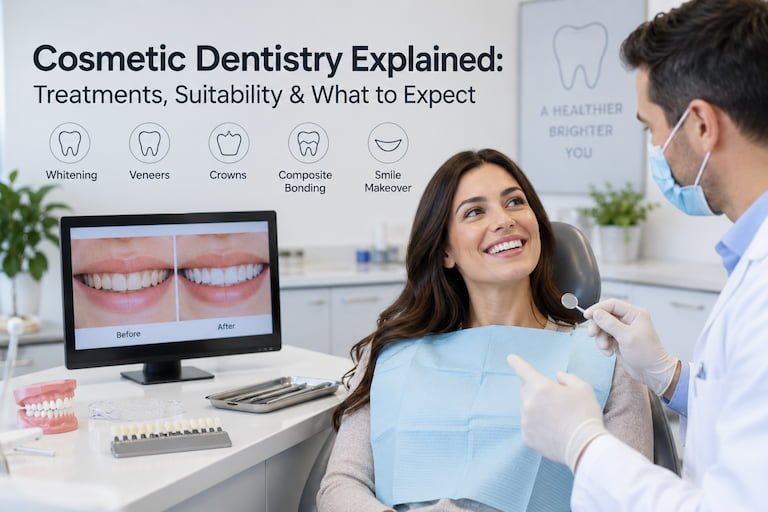
Cosmetic dentistry covers a range of dental treatments carried out primarily to improve the appearance of teeth and gums, rather than to treat disease or restore lost function. It isn’t one single procedure — the term spans everything from simple whitening to more involved treatment such as veneers, crowns, or implants, each suited to a different concern.
Most people encounter the phrase “cosmetic dentistry” long before they understand what it actually includes, and that gap is where a lot of confusion — and, occasionally, unrealistic expectations — tends to start. The sections below work through what falls under this category, what a cosmetic dentist actually does, how the main treatments compare, and how to think about suitability, cost, and longevity before booking a consultation.
What Is Cosmetic Dentistry?
Cosmetic dentistry is the area of dental practice focused on improving how teeth, gums, and the smile as a whole look, using treatments ranging from reversible, no-preparation options like whitening through to more permanent restorative work such as veneers or crowns.
It isn’t a formally recognised dental specialism in the UK — there’s no separate GDC register for “cosmetic dentist” — so it’s better understood as a treatment focus that many general dentists develop through further training and case experience, rather than a distinct qualification. This matters practically: when choosing a provider, a dentist’s specific experience with the treatment in question tends to be more informative than how a practice markets itself.
What Is Included in Cosmetic Dentistry?
Cosmetic dentistry includes teeth whitening, composite bonding, porcelain and composite veneers, cosmetic use of dental crowns, Invisalign and clear aligners, dental implants used to replace a missing tooth, gum contouring, and tooth reshaping — with treatments frequently combined as part of a broader smile makeover.
What’s excluded is just as useful to understand: treatment aimed primarily at resolving decay, infection, gum disease, or a functional bite problem is restorative or general dentistry, even where it happens to improve appearance as a side effect. In practice, many treatment plans blend both goals — a crown fitted after significant decay is restorative first, but the material and shade chosen still have a cosmetic dimension. For a broader look at how these categories relate to each other across the wider field, this complete guide to cosmetic dentistry is a useful companion to this overview.
What Does a Cosmetic Dentist Do?
A cosmetic dentist assesses oral health and tooth structure, discusses the patient’s aesthetic concerns and goals, recommends suitable treatment options, explains risks and realistic outcomes, and carries out or coordinates the chosen procedure — often alongside a hygienist or dental technician for lab-made work.
The assessment stage is where a lot of the real clinical judgement happens, even though it’s less visible than the treatment itself. Before recommending bonding, veneers, or whitening, a dentist needs to check that the gums are healthy, the bite is stable, and there’s no untreated decay, since cosmetic work placed over an unresolved problem tends to fail earlier and can mask symptoms that need attention. Where a case involves multiple procedures, the dentist’s role also includes sequencing treatment sensibly — straightening before whitening or bonding, for instance, rather than doing cosmetic work that then has to be redone once alignment changes the bite.
What Are the Most Common Cosmetic Dental Procedures?
The most common cosmetic dental procedures in the UK are teeth whitening, composite bonding, dental veneers, Invisalign, and cosmetic use of dental crowns, with dental implants, gum contouring, and tooth reshaping used for more specific concerns.
Each of these addresses a different type of concern rather than competing directly with one another: whitening changes shade, bonding and veneers change shape and shade together, Invisalign changes alignment, crowns rebuild damaged or heavily discoloured teeth, and implants replace teeth that are missing altogether. Understanding this division is often more useful for a reader than a straight list of procedures, since it points toward which category is actually relevant to a specific concern.
Teeth Whitening
Teeth whitening lightens tooth shade using peroxide-based gel, applied either in-clinic under professional supervision or at home using a dentist-supplied kit, and is generally the least invasive cosmetic treatment available since it doesn’t alter tooth structure.
It suits people whose main concern is discolouration rather than shape or alignment, and it’s often used as a starting point before other cosmetic work, since matching new restorations to a freshly whitened shade avoids a mismatch later. Results aren’t permanent — most people see whitening last from around six months to two years depending on diet and habits such as smoking, coffee, or red wine — and some temporary sensitivity is common in the days following treatment. For a closer look at how in-clinic and at-home options compare, the guide on professional teeth whitening pros and cons covers this in more detail.
Composite Bonding
Composite bonding uses tooth-coloured resin, sculpted directly onto the tooth by the dentist, to close small gaps, repair chips, or adjust minor shape irregularities, typically completed in a single visit with little to no tooth preparation required.
Bonding sits between whitening and veneers in terms of both cost and permanence — more capable of changing shape than whitening, but generally less durable than porcelain, usually lasting around five to seven years before it needs repair or replacement. Because it doesn’t require a dental laboratory, it’s often the more accessible option for patients wanting a shape change without a longer-term commitment. More detail on how the procedure works and what it can realistically achieve is covered in the guide to the composite bonding procedure and its benefits.
Dental Veneers
Dental veneers are thin shells — made from porcelain or composite resin — bonded to the front surface of a tooth to change its shape, shade, or alignment, generally used where a more significant or longer-lasting cosmetic change is wanted than bonding can provide.
Porcelain veneers usually require a small amount of enamel to be removed so the shell sits flush, which makes the treatment effectively irreversible, but they tend to hold colour and resist staining better than composite over the long term, often lasting ten to fifteen years or more. Composite veneers are more affordable and quicker to place, but generally don’t last as long. Choosing between the two materials is largely a question of budget against longevity, which is covered in more depth in the guide to dental veneers from fitting to maintenance.
Invisalign and Clear Aligners
Invisalign and other clear aligner systems straighten teeth using a series of custom, removable trays, and are used cosmetically to correct crowding, spacing, or minor bite misalignment without the fixed brackets of traditional braces.
Alignment is often the treatment that needs to happen first in a broader cosmetic plan, since straightening teeth can reduce how much bonding or veneer coverage is needed afterwards, and placing veneers or crowns before alignment risks having to redo that work once the teeth move. Clear aligner treatment typically takes several months to over a year depending on complexity, and results depend on wearing a retainer afterwards to prevent relapse. The guide on what Invisalign involves covers the process in more detail for readers considering alignment as part of a wider smile plan.
Dental Crowns
Dental crowns are full-coverage caps placed over a tooth, used cosmetically when a tooth is too damaged, worn, or discoloured for bonding or veneers to address alone, while also restoring strength where the underlying tooth structure has been compromised.
Because a crown involves reshaping the entire visible tooth to accept the cap, it requires more tooth preparation than veneers or bonding, and the decision to use one cosmetically usually reflects a tooth that needs structural support as well as an appearance change. This is one of the clearer examples of where cosmetic and restorative goals overlap in the same treatment. The guide to when a dental crown is needed, its types, and care explains this distinction in more depth.
Dental Implants and Cosmetic Dentistry
Dental implants replace a missing tooth root with a titanium post topped by a crown, and are considered cosmetic dental implants when used mainly to restore the appearance of a smile affected by a missing tooth, even though they also restore chewing function.
This is a useful example of how cosmetic and restorative purposes can sit in the same procedure: an implant replacing a tooth lost to injury may be requested largely for appearance, while the same procedure for a tooth lost to infection may be primarily restorative, even though the clinical steps are identical. Implants are among the longer-lasting cosmetic dental investments, often functioning well for fifteen to twenty-five years or more with proper care, which is worth weighing against the higher upfront cost and the surgical element involved. The guide to the benefits of dental implants covers this trade-off in more detail.
Other Cosmetic Dental Procedures
Beyond the main treatments, gum contouring reshapes an uneven or overly prominent gum line, tooth reshaping smooths small enamel irregularities, and digital smile design uses photography and planning software to preview a proposed outcome before treatment begins as part of a broader smile makeover.
These procedures are less commonly needed on their own and are more often used to refine a result achieved through whitening, bonding, veneers, or alignment. Gum contouring in particular can also have a functional benefit, since excess gum tissue can make certain areas of the mouth harder to clean effectively. Smile makeovers, meanwhile, aren’t a single procedure but a planned combination of two or more of the treatments above, sequenced to work together rather than compete.
Is Cosmetic Dentistry Expensive?
Cosmetic dentistry doesn’t have a single price because cost depends on which treatment is used, how many teeth are involved, the materials chosen, the complexity of the case, and the experience of the dentist carrying it out — meaning the honest answer is that it can range from a modest one-off cost to a significant investment.
Material is one of the biggest cost drivers: treatments involving dental laboratory work, such as porcelain veneers or crowns, generally cost more than chairside treatments like bonding or whitening, since lab fabrication adds both time and expense. Case complexity matters too — a single tooth repair is a very different cost to a full smile makeover spanning ten or more teeth. Geographic location also plays a role, with prices in London and the South East typically running higher than in other parts of the UK. Rather than a single number, cost is best understood as a range shaped by these specific factors.
How Much Does Cosmetic Dental Treatment Cost in the UK?
As a general guide, UK cosmetic dental costs tend to run from roughly a few hundred pounds for a single treatment such as whitening or composite bonding, through several hundred to over a thousand pounds per tooth for veneers or crowns, up to several thousand pounds for Invisalign, implants, or a combined smile makeover.
These figures are indicative rather than fixed, and any reader considering treatment should expect a formal, itemised quote only after an in-person assessment, since the final cost depends on exactly what a dentist finds during examination and how many teeth are actually involved. It’s also worth asking what a quote includes — consultation, diagnostic records, materials, and follow-up visits — since comparing headline prices alone can be misleading between practices.
Who Is a Suitable Candidate for Cosmetic Dentistry?
Most adults with generally healthy teeth and gums are reasonable candidates for at least one cosmetic treatment, though suitability always depends on the specific concern, the condition of the underlying tooth and gum structure, and whether expectations for the outcome are realistic.
Untreated decay, active gum disease, or an unassessed bite problem are the most common reasons cosmetic treatment needs to be delayed — not because cosmetic dentistry is unsafe in these situations, but because treatment placed over an unresolved issue is more likely to fail early or mask a symptom that needs attention. Suitability also varies by procedure: someone with significant tooth wear may be a better candidate for crowns or veneers than for whitening alone, since whitening won’t rebuild lost structure.
Benefits of Cosmetic Dentistry
The most frequently reported benefit of cosmetic dentistry is improved confidence in smiling and speaking, though several treatments also carry secondary functional benefits, such as protecting a weakened tooth edge or evening out a bite affected by wear.
Beyond the visible change, cosmetic treatment can sometimes simplify daily oral care — gum contouring, for example, can remove areas where plaque was previously difficult to reach. It’s worth noting that these benefits vary by treatment and individual case, and no cosmetic procedure can guarantee a specific outcome; a dentist should always discuss what’s realistically achievable for the tooth or teeth in question before treatment begins.
Limitations and Risks
Cosmetic dental treatments carry different limitations and risks depending on the procedure, ranging from temporary sensitivity after whitening, to the permanent removal of enamel for veneers and crowns, to a higher chance of staining or chipping with composite bonding compared with porcelain alternatives.
None of the main cosmetic treatments are entirely without downsides. Whitening can cause temporary sensitivity and its results fade over time. Veneers and crowns involve irreversible tooth preparation, meaning the tooth will always need some form of covering afterwards. Bonding, while reversible in principle, is more prone to chipping and staining and typically needs replacing sooner than porcelain. Implants carry the general risks associated with any surgical dental procedure. A proper consultation should cover these limitations honestly rather than presenting any cosmetic treatment as risk-free.
Cosmetic Dentistry vs Restorative Dentistry
Cosmetic dentistry is chosen primarily for appearance, while restorative dentistry is chosen primarily to treat disease, damage, or lost function — though the two frequently overlap, since the same procedure, such as a crown or bonding, can serve either purpose depending on why it’s being carried out.
This distinction matters practically because it affects both treatment planning and, in some cases, NHS eligibility, since NHS dental care is generally focused on restorative rather than purely cosmetic treatment. A tooth that’s both decayed and visibly discoloured, for instance, might be treated with a crown that addresses both goals at once, in which case the underlying clinical need — rather than the appearance improvement — usually determines how the treatment is classified and funded.
How to Choose the Right Cosmetic Dental Treatment
Choosing the right cosmetic treatment starts with identifying the specific concern — colour, shape, alignment, or a missing tooth — then working through dental assessment, treatment options, suitability, risks, expected longevity, maintenance, and cost before deciding between alternatives.
As a general rule, dentists tend to recommend starting with the least invasive treatment capable of achieving the desired result, moving to something more involved only where that won’t be enough — whitening before bonding, bonding before veneers, veneers before crowns. Working through concern, assessment, and options in that order, rather than starting from a specific procedure name, tends to lead to a more appropriate treatment plan than picking a treatment first and working backwards.
Looking After Cosmetic Dental Work
Maintaining cosmetic dental work relies mainly on the same fundamentals as general oral health — thorough brushing, interdental cleaning, and regular dental checkups — alongside a few treatment-specific precautions such as avoiding biting hard objects and managing staining habits.
Whitened teeth benefit from limiting coffee, tea, red wine, and smoking in the days immediately after treatment. Bonded and veneered teeth are more vulnerable to chipping from biting into hard foods or using teeth as tools. Anyone who grinds their teeth at night is generally advised to wear a guard regardless of which cosmetic treatment they’ve had, since grinding is one of the most common causes of early damage to bonding, veneers, and crowns alike. Regular reviews also allow a dentist to catch early wear or staining before it becomes a bigger repair.
Comparison Tables
Cosmetic Procedure Comparison
| Treatment | Main Cosmetic Purpose | Tooth Preparation | Relative Longevity | Main Limitation |
|---|---|---|---|---|
| Teeth whitening | Shade change | None | 6 months–2 years | Sensitivity, results fade |
| Composite bonding | Minor shape/gap correction | Minimal to none | 5–7 years | More prone to chipping/staining |
| Composite veneers | Shape and shade change | Minimal | 5–8 years | Shorter lifespan than porcelain |
| Porcelain veneers | Shape and shade change | Light enamel removal | 10–15+ years | Irreversible preparation |
| Dental crowns | Shape, shade, structural rebuild | Significant | 10–15+ years | Most invasive preparation |
| Invisalign | Alignment | None | Permanent with retention | Requires consistent wear |
| Dental implants | Missing tooth replacement | Surgical placement | 15–25+ years | Surgical procedure, higher cost |
| Gum contouring | Gum line appearance | Soft tissue only | Long-term | Not suitable for all gum conditions |
Treatment Selection Table
| Concern | Potentially Relevant Treatment(s) |
|---|---|
| Tooth colour | Teeth whitening; veneers where shape also needs changing |
| Minor chips | Composite bonding |
| Tooth shape | Composite bonding, veneers |
| Small gaps | Composite bonding, veneers, or Invisalign for larger spacing |
| Alignment | Invisalign or other clear aligners |
| Missing teeth | Dental implants |
| Gum display | Gum contouring |
Cost Consideration Table
| Cost Driver | Effect |
|---|---|
| Number of teeth treated | More teeth generally increases total cost |
| Materials used | Porcelain/ceramic typically costs more than composite |
| Laboratory involvement | Lab-made work (veneers, crowns) adds cost versus chairside treatment |
| Case complexity | Multi-treatment plans cost more than a single procedure |
| Dentist experience | More experienced cosmetic dentists may charge higher fees |
| Location | Prices tend to be higher in London and the South East |
Suggested Visuals
- Concern-to-treatment pathway diagram (colour, shape, alignment, missing teeth → treatment category)
- Cosmetic procedure comparison chart (longevity vs invasiveness)
- Simple illustration of the main cosmetic dental procedures
- Cosmetic vs restorative dentistry diagram showing overlap
Frequently Asked Questions
What is included in cosmetic dentistry?
Cosmetic dentistry includes treatments such as whitening, composite bonding, veneers, cosmetic crowns, Invisalign, dental implants, gum contouring, and tooth reshaping, typically chosen based on the specific aesthetic concern.
Is cosmetic dentistry expensive in the UK?
Cost varies widely depending on the treatment, number of teeth involved, and materials used, ranging from a modest single-treatment cost to a more significant investment for a full smile makeover.
Can cosmetic dentistry include implants?
Yes — dental implants are considered cosmetic when used mainly to restore the appearance of a smile affected by a missing tooth, even though they also restore chewing function at the same time.
Can cosmetic dentistry improve the appearance of missing teeth?
Yes, typically through dental implants, bridges, or in some cases orthodontic space closure, depending on the position of the missing tooth and the patient’s broader treatment goals.
Does cosmetic dentistry always involve veneers?
No — veneers are only one of several cosmetic options, and many concerns, such as discolouration or minor chips, are better addressed with whitening or composite bonding instead.
Can cosmetic dentistry damage natural teeth?
Some procedures, such as veneers and crowns, involve removing a layer of healthy enamel, which is why less invasive options are generally considered first where they can achieve a similar result.
How long does cosmetic dental work usually last?
This depends heavily on the treatment — whitening may need topping up within a year or two, while porcelain veneers, crowns, and implants can often last a decade or more with proper care.
Can cosmetic dentistry be combined with orthodontic treatment?
Yes, this is common — alignment with Invisalign is often carried out before other cosmetic work, since straightening teeth first can reduce how much bonding or veneer coverage is needed afterwards.
Is every cosmetic dental procedure suitable for every patient?
No — suitability depends on the condition of the teeth and gums, existing dental work, and the specific concern being addressed, which is why a proper assessment always precedes any recommendation.
Clinical Disclaimer
This article is intended for general educational purposes only and should not replace personalised advice from a qualified dental professional. Suitability, treatment costs, and expected outcomes vary depending on individual oral health, treatment goals, and clinical assessment. Where appropriate, readers should seek advice from a registered dental professional and follow current NHS guidance for urgent dental concerns rather than pursuing cosmetic treatment.
