


Introduction
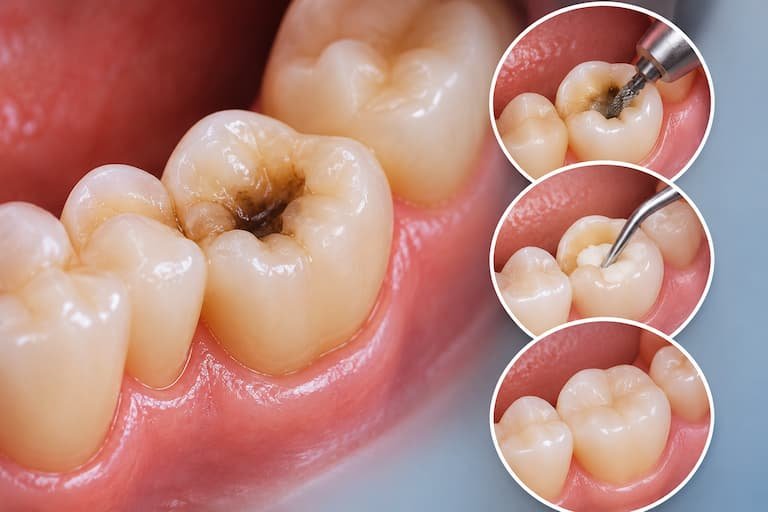
A tooth filling is one of the most common restorative dental treatments, used to repair a tooth affected by decay, wear, or minor damage by filling the cleaned-out area with a suitable material. Most adults in the UK will need at least one filling during their lifetime, and understanding what the treatment actually involves can make the process considerably less daunty than it sounds.
In practical terms, a filling restores the tooth’s shape and function after decayed or damaged tissue has been removed, using a material selected to suit the tooth’s location, the size of the area being treated, and the bite forces it needs to withstand. Fillings sit within the wider field of cosmetic and restorative dental treatments available in the UK, though a standard filling is a restorative rather than a cosmetic procedure.
What Is a Dental Filling?
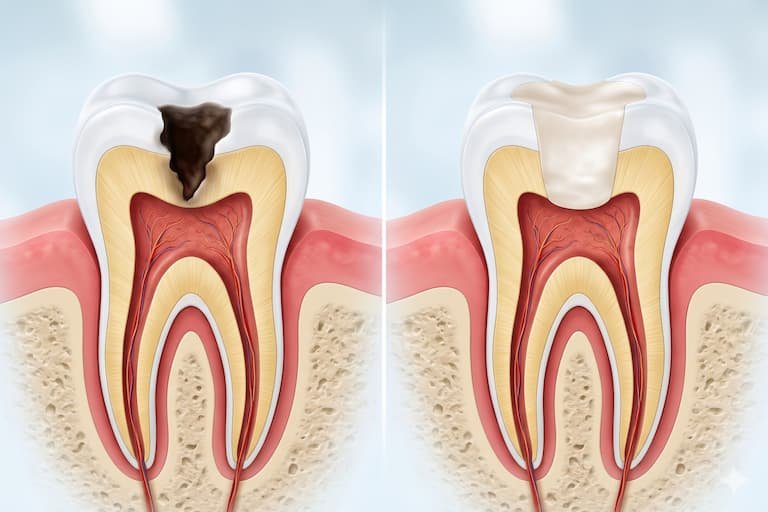
A dental filling is a restoration placed into a tooth after decayed or damaged material has been removed, designed to restore the tooth’s strength, shape, and ability to function normally when biting and chewing. A filling repairs localised damage; it does not reverse decay elsewhere in the mouth or substitute for ongoing oral hygiene.
It’s worth distinguishing a cavity from a filling at the outset: a cavity is the hole or area of decay itself, while a filling is the material used to repair it once the decay has been cleaned out. Readers wanting to understand how restorative work differs from purely appearance-focused treatment may find it useful to read this overview of cosmetic dentistry, since the two are often confused despite serving different purposes.
A filling can restore a tooth affected by decay, minor cracks, or wear, but it cannot repair extensive structural damage — in those cases, a dentist may discuss alternative restorations instead.
What Are the Signs You Need a Tooth Filling?
Possible signs that a tooth may need a filling include sensitivity to hot, cold, or sweet foods, a visible hole or dark area on the tooth, food repeatedly getting trapped in the same spot, toothache, or a rough or damaged tooth surface noticeable to the tongue. Some of these signs are noticeable to the person affected, while others are only identified during a dental examination.
It’s worth noting that some cavities cause no noticeable symptoms at all, particularly in the early stages, which is one of the main reasons regular dental check-ups and radiographs matter even when nothing feels obviously wrong.
What Causes Tooth Decay?
Tooth decay develops when plaque — a sticky film of bacteria — breaks down sugars from food and drink into acids that gradually demineralise the tooth’s enamel and, if left unaddressed, progress into the underlying dentine. Diet, oral hygiene, saliva, and fluoride exposure all influence how quickly this process happens.
Good oral hygiene and reduced frequency of sugary food and drink can help prevent new decay, but they cannot reverse a cavity that has already formed; at that stage, a dental assessment is needed to determine the appropriate treatment.
What Types of Tooth Filling Are Available?
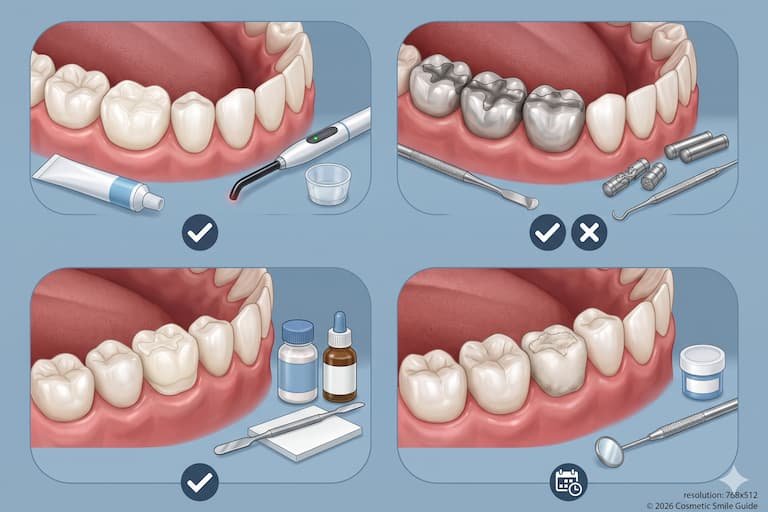
The main filling materials used in the UK are composite resin, dental amalgam, and glass ionomer cement, alongside temporary filling materials used for short-term protection; each has different appearance, strength, and typical-use characteristics, and no single material is universally superior for every situation.
Composite resin fillings are tooth-coloured and bond directly to the tooth, making them a common choice where appearance matters, including on visible front teeth. The material and bonding approach share similarities with composite bonding and tooth-coloured resin used in cosmetic dentistry, though the clinical purpose differs — a filling repairs decay, while bonding is typically used to reshape or improve the appearance of an otherwise healthy tooth.
Amalgam fillings are a silver-coloured metal alloy historically used for back teeth due to their strength and durability, though their use has declined over recent years.
Glass ionomer fillings release fluoride and bond chemically to the tooth, and are sometimes used in specific clinical situations, including for some paediatric or lower-stress applications.
Temporary fillings are designed for short-term use — to protect a tooth between appointments or while a more permanent restoration is planned — and are not intended as a long-term solution.
Composite vs Amalgam Tooth Filling
Composite and amalgam fillings differ mainly in appearance, placement technique, and typical suitability: composite is tooth-coloured and bonds directly to enamel and dentine, while amalgam is silver-coloured and relies on mechanical retention within the cavity shape. Material choice depends on the tooth’s location, the size of the cavity, moisture control during placement, and the bite forces the restoration will need to withstand.
Neither material is automatically the better choice in every case. A similar tooth-coloured resin is also used in composite bonding, which can be a useful comparison point for readers curious about how the same base material performs differently depending on whether it’s repairing decay or reshaping a healthy tooth. A dentist’s clinical assessment, rather than appearance preference alone, should guide the final decision.
Tooth Filling Procedure Step by Step
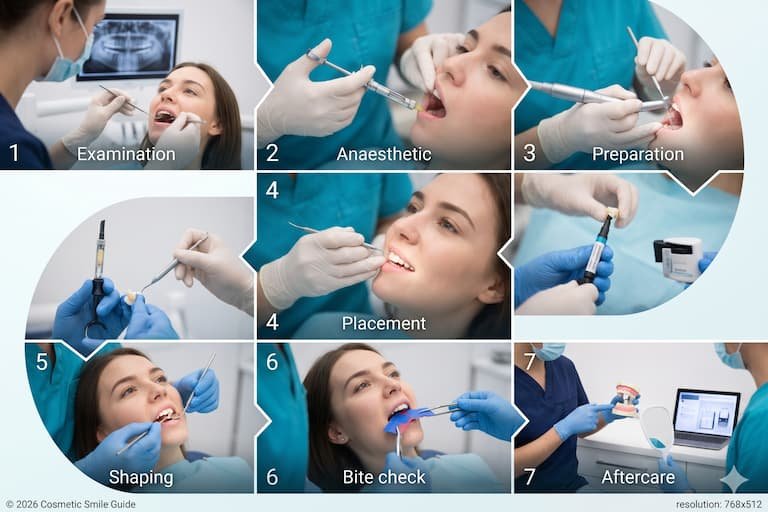
The typical filling procedure involves a dental examination and assessment, local anaesthetic where needed, removal of decayed or damaged tissue, preparation of the tooth, placement of the chosen filling material, shaping and adjustment, a bite check, and aftercare instructions. The exact sequence and time required vary depending on the tooth, the material used, and the extent of decay.
Not every step applies to every case — a very small or early-stage cavity may require a shorter, simpler procedure than a larger or more complex one, and a dentist will explain what to expect for the specific tooth being treated.
Does a Tooth Filling Hurt?
Most people experience little to no pain during a filling because local anaesthetic is used to numb the area beforehand; some pressure or vibration may still be felt during preparation, and mild sensitivity is common for a short period afterwards as the anaesthetic wears off. The procedure is not generally described as painful, though individual experiences vary.
If pain persists, worsens, or becomes severe after a filling, rather than gradually settling, it’s worth arranging a dental review rather than assuming it will resolve on its own.
How Long Does a Tooth Filling Last?
A filling’s lifespan depends on the material used, the size of the restoration, the tooth’s location, bite forces, habits such as teeth grinding, oral hygiene, and diet, rather than on a single fixed figure that applies to every case. Larger fillings and those on heavily used back teeth may be more prone to wear over time than smaller restorations on less pressured teeth.
Regular dental reviews allow a dentist to monitor a filling’s condition and identify early signs of wear before they become more significant problems.
How Much Does a Tooth Filling Cost in the UK?
The cost of a tooth filling depends on whether treatment is carried out on the NHS or privately, which material is used, the tooth involved, and the size and complexity of the restoration. NHS dental charges in England are banded, with a filling typically falling under a specific treatment band, while private fees vary by practice, material, and case complexity; current charges should always be checked against up-to-date NHS or practice information rather than assumed from memory.
In situations where decay is extensive and a filling alone may not be able to restore the tooth adequately, a dentist may discuss when a dental crown may be needed as an alternative restoration. For readers comparing material costs more broadly, it’s worth noting that composite bonding pricing — which uses a similar tooth-coloured resin — follows different cost logic again, since bonding is typically a cosmetic rather than NHS-funded treatment.
What Should You Eat After a Tooth Filling?
It’s generally sensible to wait until any numbness from local anaesthetic has fully worn off before eating, to avoid accidentally biting the cheek, lip, or tongue, and some materials benefit from a short period before chewing directly on the treated tooth. A dentist will usually give specific guidance based on the material used and the tooth treated.
Softer foods may feel more comfortable in the first day or so if the area feels sensitive, though this varies by individual and by the extent of the treatment carried out.
Tooth Filling Sensitivity to Cold
Temporary sensitivity to cold after a filling is common and usually settles within a few days to a few weeks as the tooth adjusts to the new restoration. This differs from sensitivity that persists well beyond that timeframe, worsens, or occurs without any obvious trigger, which may indicate the filling needs reviewing.
If sensitivity doesn’t improve or becomes more noticeable over time, it’s worth mentioning to a dentist rather than assuming it will resolve by itself indefinitely.
Why Does My Tooth Filling Hurt When Chewing?
Pain when chewing after a filling can result from a filling sitting slightly too high (a “high bite”), ongoing post-treatment sensitivity, irritation of the tooth’s nerve, an underlying crack, or a problem with the restoration itself. A dentist can usually identify the cause through examination and, where needed, a simple bite adjustment.
Persistent or worsening pain when chewing shouldn’t be ignored, since early review can sometimes resolve a straightforward bite issue before it becomes a larger problem.
Can a Tooth Filling Fall Out?
Yes, a filling can become loose or fall out, often due to wear over time, decay developing underneath or around the restoration, or trauma such as biting something hard. If this happens, it’s worth protecting the area, avoiding chewing directly on the affected tooth where possible, and arranging a dental appointment promptly, since the exposed tooth may be more vulnerable in the meantime.
A missing filling is not usually a dental emergency on its own, but it should be assessed reasonably soon to prevent further damage or discomfort.
What Are the Signs a Tooth Filling Needs Replacement?
Signs that a filling may need replacing include visible cracks, noticeable wear, a filling that feels loose or has partially come away, recurrent decay developing around the restoration’s edges, persistent sensitivity, food repeatedly trapping in the same spot, or a change in how the bite feels. A dentist needs to assess which of these, if any, apply before deciding whether repair, replacement, or a different type of restoration is the right next step.
Recurrent decay around an existing filling is a particularly important sign to catch early, since it can progress underneath a restoration that otherwise looks intact from the surface.
Temporary Tooth Filling vs Permanent Filling
Temporary fillings are designed to protect a tooth for a limited period — often between appointments or while a more extensive treatment plan is finalised — using materials not intended for long-term use, while permanent fillings are placed as the definitive restoration. Temporary fillings typically wear down more quickly and aren’t built to withstand normal biting forces indefinitely.
If a temporary filling has been placed, it’s important to attend the planned follow-up appointment rather than treating it as a lasting solution.
How to Care for a Tooth Filling
Caring for a filling involves brushing with fluoride toothpaste, cleaning between teeth daily, limiting frequent sugar exposure, avoiding habits that place unnecessary strain on the restoration such as chewing ice or hard objects, attending regular dental reviews, and following any specific aftercare instructions given after treatment. These habits support both the filling and the surrounding natural tooth structure.
Consistent care reduces the likelihood of recurrent decay developing around the edges of an existing filling, which is one of the more common reasons restorations eventually need attention.
When Is a Filling Not Enough?
A filling may not be sufficient when tooth damage is too extensive for the remaining structure to support a standard restoration, in which case a dentist may discuss alternatives such as an inlay, onlay, or dental crown treatment depending on the specific situation. Which option is appropriate depends entirely on clinical assessment rather than a general rule.
This isn’t a sign that something has gone wrong with the original filling necessarily — some teeth simply require more extensive restoration from the outset, particularly where a large portion of the tooth has been affected by decay or previous treatment.
Conclusion
A tooth filling repairs a tooth affected by decay or minor damage, restoring its shape and function using a material selected to suit the specific tooth and case. Material choice, the procedure itself, costs, and longevity all depend on individual circumstances rather than a single standard answer, which is why professional assessment matters more than comparing headline figures or material names alone.
Readers who are also exploring the cosmetic side of dentistry — whether that’s addressing the appearance of a filled tooth or planning treatment more broadly as part of a smile makeover — may find it useful to look at how restorative and cosmetic goals can sit alongside each other, since the two are often considered together once decay has been addressed. This guide, like the rest of the educational content on Cosmetic Smile Guide, is intended to support an informed conversation with a registered dental professional rather than to replace one, and fillings remain one part of the wider field of cosmetic dentistry treatments many readers end up exploring once a restorative issue has been resolved.
5. COMPARISON TABLES
Filling Material Comparison
| Material | Appearance | Typical Use | Limitations |
|---|---|---|---|
| Composite resin | Tooth-coloured | Visible teeth, smaller-to-moderate cavities | Can be technique-sensitive; moisture control needed during placement |
| Amalgam | Silver-coloured | Historically back teeth | Less aesthetic; use has declined |
| Glass ionomer | Tooth-coloured/opaque | Specific clinical situations | Generally less durable under heavy bite forces |
| Temporary material | Varies | Short-term protection | Not intended for long-term use |
Material Suitability and Limitations
| Factor | Consideration |
|---|---|
| Tooth location | Front vs back teeth influence material suitability |
| Cavity size | Larger cavities may limit material options |
| Moisture control | Some materials require a dry field during placement |
| Bite forces | Back teeth generally bear greater load |
Temporary vs Permanent Fillings
| Aspect | Temporary Filling | Permanent Filling |
|---|---|---|
| Purpose | Short-term protection | Definitive restoration |
| Expected duration | Days to weeks | Years, case-dependent |
| Typical use | Between appointments | Final treatment |
| Follow-up required | Yes, usually planned | Routine review only |
Procedure Stages
| Stage | What Happens |
|---|---|
| Examination | Assessment of decay and suitability |
| Anaesthetic | Local anaesthetic where needed |
| Preparation | Removal of decayed tissue |
| Placement | Filling material applied |
| Shaping | Contouring to match tooth anatomy |
| Bite check | Adjustment for comfortable bite |
| Aftercare | Guidance on eating and care |
Cost Factors and Sensitivity/Aftercare Considerations
| Factor | Effect |
|---|---|
| NHS vs private | Different fee structures apply |
| Material | Can influence cost |
| Restoration size | Larger fillings may cost more |
| Post-treatment sensitivity | Usually temporary; persistent sensitivity needs review |
| Aftercare consistency | Supports longevity and reduces recurrent decay risk |
7. FAQ SECTION
How soon can I eat after a tooth filling?
This depends on the material used and whether local anaesthetic was given; many dentists advise waiting until numbness has fully worn off to avoid biting the cheek or tongue. Your dentist will usually give specific timing guidance for your treatment.
Is a filling the same as a root canal?
No. A filling repairs localised decay or damage within the tooth structure, while root canal treatment addresses infection or damage reaching the tooth’s nerve and is a more extensive procedure. A dentist can explain which applies to your situation.
Can a filling be whitened along with natural teeth?
Tooth whitening generally affects natural tooth enamel rather than filling materials, which don’t respond to whitening the same way. If a filling is on a visible tooth, it’s worth discussing colour matching with a dentist before or after whitening.
Will I need an X-ray before getting a filling?
Not always, but dental radiographs are commonly used to assess the extent of decay, particularly between teeth or beneath the surface where it isn’t visible directly. Your dentist will advise whether one is needed for your specific case.
Can I get a filling on the NHS in the UK?
Yes, fillings are typically covered under NHS dental care in England, Scotland, Wales, and Northern Ireland, usually falling under a specific treatment charge band where NHS charges apply. Current charge information should be checked against official NHS guidance.
How many fillings can be done in one appointment?
This depends on the number of teeth affected, their location, and the dentist’s clinical judgement; sometimes several smaller fillings can be completed in one visit, while more extensive treatment may be spread across appointments.
Does a filling need to match my tooth colour exactly?
Composite fillings are typically shade-matched to surrounding teeth, particularly on visible teeth, though an exact match isn’t always guaranteed and can depend on the specific case and material used.
Can old amalgam fillings be replaced with composite?
In some cases, yes, though replacement isn’t automatically recommended purely for cosmetic reasons unless the existing filling also shows signs of wear, damage, or decay. A dentist can assess whether replacement is clinically appropriate.
10. CLINICAL DISCLAIMER
This article is for general educational purposes only and does not constitute dental advice. It is not a substitute for an in-person assessment by a registered dental professional, who can evaluate individual suitability, symptoms, and treatment options. NHS and private cost information referenced should always be checked against current official sources. If you experience severe pain, facial swelling, spreading infection, or difficulty swallowing, contact NHS 111 or seek urgent dental care immediately.
